Jurisdiction as a Service: Why Swiss Law Is a Layer in Our Tech Stack
A technical analysis of why jurisdiction belongs inside the sovereignty stack, not outside it.
Updated August 19, 2026.
1. Executive Summary: Jurisdiction Is a Stack Layer
For sovereign hardware, jurisdiction is not a corporate detail. It is part of the security boundary. Cryptography can protect data against technical extraction; jurisdiction shapes the rules for lawful access, retention, and disclosure. If an operator can access or reconstruct user data, the trust hierarchy around the system matters alongside the cipher.
CLAVI treats Swiss jurisdiction as a structural layer that works in concert with ClavOS, the Monolith, and zero-knowledge architecture. The technical goal is to keep recoverable vault secrets outside operator custody. The legal goal is to operate within Switzerland’s constitutional and statutory data-protection framework. Together, those layers create an environment designed for digital sovereignty rather than custodial convenience.
| Layer | What it secures | Failure mode if absent |
|---|---|---|
| Hardware | Physical key isolation and signing authority | Keys collapse into a single device or recoverable backup |
| Operating system | Remote access minimisation and local control | The vendor or attacker inherits software-level reach |
| Jurisdiction | Rules governing operator-side duties and disclosure | Applicable disclosure and retention duties are overlooked |
| Zero-knowledge design | Technical non-possession of user secrets | The operator remains inside the information flow |
This analysis explains why CLAVI selected Schaffhausen, why Article 13 and the revFADP matter, and why minimizing operator possession of recoverable vault secrets can limit what is available for breach or lawful disclosure.
2. The Limits of Cryptography
Encryption is necessary, but it is not sufficient. If a provider can access, recover, log, or reconstruct user data, then the decisive risk is legal and organizational, not cryptographic.
This is the hidden weakness in cloud-dependent systems. Even where transport encryption is robust, the operator still sits somewhere inside the compliance perimeter. For critical assets, family-office treasury, private communications, or proprietary AI workflows, the relevant question is not simply, “Is this encrypted?” It is: “Who can be compelled, under which laws, to produce what they know?”
That is why sovereign hardware cannot be evaluated only by key storage, chip choice, or signing flow. It must also be evaluated by the legal environment surrounding the manufacturer and operator. A system that routes sensitive operations through provider-visible infrastructure inherits a second-order vulnerability: the vulnerability is not in the algorithm, but in the operator’s position in the hierarchy.
For a deeper technical framing of that distinction, see Why CLAVI Isn’t Competing with Ledger.
3. Why Switzerland Is Load-Bearing in the CLAVI Architecture
CLAVI is incorporated in Schaffhausen, Switzerland and presents that legal environment as one part of its security model. Jurisdiction can shape operator duties and remedies, but it does not certify the hardware or make privacy unconditional.
This is why CLAVI’s Swiss domicile is load-bearing rather than ornamental. The company sits outside the European Union and outside the Five Eyes intelligence-sharing alliance. That changes the governing legal framework, but it does not remove Swiss statutory duties, international cooperation, or the possibility of lawful requests.
For a sovereign hardware company, domicile is not a branding choice. It is part of the operating environment in which trust assumptions are evaluated. The legal perimeter should support the hardware perimeter while acknowledging the duties that apply to the company and its retained business records.
The defensible position is narrower: architecture may reduce which user secrets enter operator custody, while Swiss law governs the personal and corporate records that remain. Neither layer eliminates implementation risk or lawful process.
4. Article 13 Makes Privacy Constitutional
Article 13 of the Swiss Federal Constitution treats privacy as a fundamental right. That matters because privacy is placed inside the legal architecture of the state itself, not treated as a revocable product policy. [1]
At the systems level, that constitutional baseline is relevant to the environment in which CLAVI operates. It does not create immunity from statutory duties, proportionate restrictions, court orders or international cooperation.
For a company building sovereignty-focused infrastructure, that distinction can be material. The legal framework provides rights and duties that must be assessed alongside the product objective of minimizing third-party access to user secrets. Jurisdiction does not replace engineering, compliance analysis or case-specific legal review.
This is one of the central differences between privacy as messaging and privacy as architecture.
5. The revFADP Aligns with Privacy by Design
Since September 2023, the revised Federal Act on Data Protection (revFADP) has required privacy by design and privacy-friendly default settings where applicable. For CLAVI, this legal logic maps directly onto the product logic. [2]
CLAVI’s architecture is designed to reduce the amount of sensitive vault information that exists at the operator layer in the first place: fewer retained secrets, fewer exposed interfaces, and less material available for breach or compelled disclosure. That does not eliminate the commerce, delivery, account, support, security, accounting, or other records a business may need to process and retain for defined purposes. CLAVI’s data-minimization analysis explains how those separate data planes require different controls.
The revFADP is therefore relevant not because CLAVI relies on legal promises instead of engineering, but because the legal framework requires data protection by design and default where applicable. Product architecture and business-record governance remain separate compliance questions.
For family offices and sovereignty-focused operators, that alignment matters. The legal layer and the technical layer do not perform the same job, but they do reinforce the same outcome.
6. The Reporting Era Makes Non-Possession More Important
As of August 19, 2026, Switzerland’s State Secretariat for International Finance says the Swiss legal basis for CARF does not apply in 2026 and implementation can begin no earlier than January 1, 2027. Partner-jurisdiction decisions are part of the remaining process. CARF concerns in-scope reporting crypto-asset service providers and defined identity and transaction data; it is not a universal requirement for every hardware provider to maintain a database of customer holdings. [3][4]
This is the jurisdictional tension of modern custody. The more relevant data an in-scope provider holds, the more may be subject to retention, reporting, breach, or lawful disclosure obligations. Whether a particular duty applies depends on the provider’s functions, facts, and legal classification.
That is why CLAVI’s model is not built around defending a large operator-side vault repository. It is designed to keep private keys, wallet-to-customer mappings derived locally, and local proprietary CLAVI AI prompts outside operator custody. This is a product design claim that requires engineering verification. It should not be confused with a claim that CLAVI Switzerland AG holds no personal data: necessary commercial, support, security, and accounting records remain a separate data-governance responsibility.
Cloud-based custody or intelligence systems may inherit broader disclosure and reporting exposure when they remain inside the information flow, including under frameworks such as the U.S. CLOUD Act where it applies. [5] The technical question is therefore inseparable from the jurisdictional one: how much sensitive knowledge is centralized, where is it held, and under which laws can it be reached?
7. Zero-Knowledge Architecture Can Limit What an Operator Can Produce
Architectural non-possession is one effective exposure-reduction measure. If the operator does not hold keys, prompts or recoverable user secrets, those materials ordinarily are not available from its existing custody. Authorities may still seek other records or prospective measures within their lawful powers.
That is the operating logic of CLAVI.
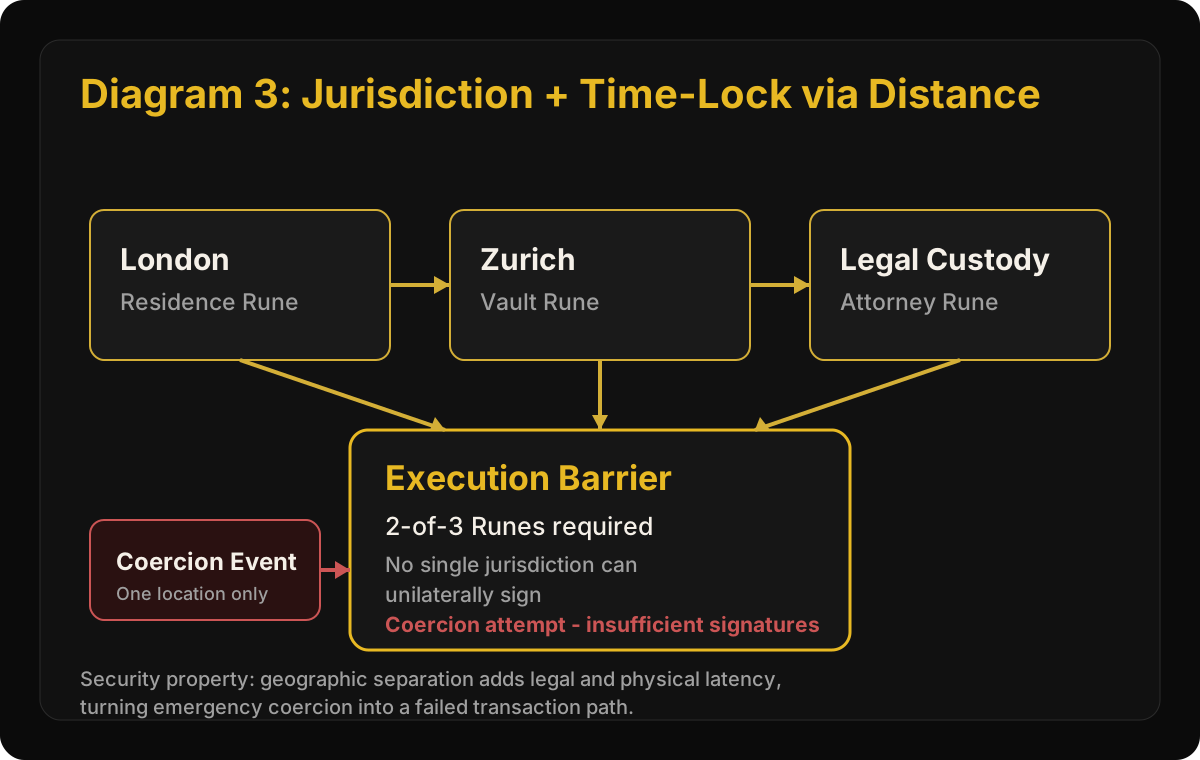
ClavOS, the Monolith, and the Rune model are documented by CLAVI as being designed to:
- avoid operator-held recovery credentials for vault secrets,
- minimize persistent operator telemetry on critical user operations,
- keep private keys outside operator custody,
- keep local proprietary CLAVI AI prompts and outputs outside the operator layer.
This is where the technical and legal layers compound:
- The legal layer: Swiss constitutional privacy protections and the revFADP govern privacy and data handling. [1][2]
- The technical layer: CLAVI is designed to keep vault secrets outside operator custody, limiting what the operator can retrieve.
- The operational layer: CLAVI’s stated target is local validation, hardware-gated approval and distributed authority; the deployed boundary requires engineering verification.
That is the meaning of jurisdictional hardening. Jurisdiction is not replacing cryptography. It is protecting the same sovereignty model from the legal side.
For a broader continuity and estate-planning perspective, see CLAVI: Building a Personal Digital Vault for High-Level Businesses and Families.
8. Documented Glossary of Technical Terms
To keep the argument precise, four terms matter:
- Trust Hierarchy: the chain of delegated authority inside a digital system. Sovereignty begins where that chain terminates.
- Zero-Knowledge Architecture: CLAVI’s term for a design intended to keep private keys and local vault content outside operator custody. It does not mean the company holds no commerce, support, security, accounting, or other legally required records.
- Swiss Jurisdiction: the legal environment in which Article 13 and the revFADP reinforce privacy as a structural right.
- Jurisdictional Hardening: the practice of selecting and designing for a legal environment that supports the same sovereignty model enforced by the hardware.
These are not adjacent ideas. They describe different layers of the same stack.
9. Frequently Asked Questions
Q: Why does jurisdiction matter if the system is already encrypted?
A: Because encryption protects against technical extraction, not operator-side legal compulsion. If the operator can access, retain, or reconstruct user data, jurisdiction determines what that operator may be forced to disclose.
Q: Does Swiss jurisdiction replace zero-knowledge architecture?
A: No. Jurisdiction governs legal exposure, while CLAVI uses zero-knowledge architecture to describe an intended technical boundary around operator access. Whether that boundary is achieved depends on implementation and engineering verification.
Q: Why is Swiss law relevant to sovereign hardware specifically?
A: Sovereign hardware is not only about where keys are stored. It is also about which legal system surrounds the manufacturer, operator, and support structure. For CLAVI, Swiss law reinforces the same privacy logic that the hardware and operating system are built to enforce.
10. Works Cited
- Swiss Federal Constitution, Article 13 (Right to Privacy). Fedlex. (https://www.fedlex.admin.ch/eli/cc/1999/404/en)
- Revised Federal Act on Data Protection (revFADP). Federal Data Protection and Information Commissioner (FDPIC). (https://www.edoeb.admin.ch/edoeb/en/home.html)
- Crypto-Asset Reporting Framework (CARF). OECD. (https://www.oecd.org/en/publications/international-standards-for-automatic-exchange-of-information-in-tax-matters_896d79d1-en/full-report/component-6.html)
- Framework for the automatic exchange of information on crypto-assets. Swiss State Secretariat for International Finance. (https://www.sif.admin.ch/en/framework-for-the-automatic-exchange-of-information-aeoi-on-crypto-assets)
- CLOUD Act of 2018. U.S. Department of Justice. (https://www.justice.gov/dag/cloudact)