CLAVI: Building a Personal Digital Vault for High-Level Businesses and Families
The distinction between a custody product and a Personal Vault is the distinction between protecting a transaction and protecting a legacy.

1. Introduction: The Distance Between Two Mornings
A Tuesday morning, early. A family office in Zurich receives word that a major exchange has frozen withdrawals. Within the hour, a second platform follows. Twitter erupts. Telegram channels fill with a particular kind of panic: not retail panic, but the quiet, cold recognition of institutional exposure. Lawyers begin drafting letters that no one will read in time.
In a quieter office, on a quieter street, a different kind of morning is unfolding. A principal reviews her portfolio over coffee. Every position is visible, every asset accounted for, every key under her direct control. She is not refreshing a withdrawal page. She is not waiting for permission to access what is hers. She reads the headlines with the detached curiosity of someone watching a storm from the other side of reinforced glass.
The distance between these two mornings is partly architectural. One family entrusted access to a third-party custodian; the other reduced that dependency through self-controlled infrastructure. Self-custody introduces its own implementation, recovery and physical-security risks, so custodian solvency is only one part of the comparison.
That infrastructure—the coordinated layer of custody, governance, intelligence, and succession that treats digital assets with the seriousness of a multi-generational estate—is what a Personal Digital Vault provides.
It is not merely a wallet with more features. It is a governance and continuity model for digital wealth that should be designed, documented and tested across generations.
2. Why Wealth That Outlasts Generations Demands Infrastructure That Outlasts Products
Many of us who manage wealth across decades share an instinct that the market has been slow to acknowledge: the tools built for trading are not the tools required for permanence.
A family that has spent sixty years compounding capital across property, equities, trusts, and now digital assets does not think in product cycles. It thinks in generations. The patriarch does not ask which exchange offers the lowest fees this quarter. He asks whether his grandchildren will be able to access, govern, and transfer the digital estate he is building now: thirty years from now, under laws that have not yet been written, using institutions that may no longer exist.
This is the temporal mismatch at the heart of crypto wealth management for high-net-worth families: the industry builds for speed, but the client builds for permanence. Exchanges optimise for throughput. Hardware custody devices optimise for the next transaction. Neither is designed to answer the question that actually keeps a family office CIO awake: what happens in year fifteen?
Real estate has title registries, generational trusts and centuries of legal infrastructure supporting ownership. BNY’s 2025 survey reported that 74% of participating family-office professionals were already invested in cryptocurrency or actively considering it [1]. That growing interest does not mean digital assets have mature succession infrastructure. Many arrangements still depend on seed backups, safe-deposit instructions and heirs who understand how to execute them.
The gap is not technical. It is philosophical. We have been treating generational wealth with the infrastructure of a day trade.
3. The Custody Trilemma: Convenience, Security, and Sovereignty
Every custody decision involves a trade-off between three properties, and understanding this trilemma is the first step toward recognising why the current landscape is structurally inadequate.
| Dimension | Primary Provider | The Cost / Failure Mode |
|---|---|---|
| Convenience | Centralized Exchanges | Provider Dependence: Customer access can depend on the provider’s controls, solvency, governance and safeguarding arrangements; failures can harm customers (e.g., FTX). |
| Security | Conventional single-device or single-seed hardware-wallet setup | Concentration Risk: One device or seed can create a single point of failure vulnerable to physical theft or loss. |
| Sovereignty | Personal Vault architecture | Architectural demand: Reduce unnecessary provider access while preserving lawful, tested recovery and governance. |
Convenience is one benefit exchanges can provide. The cost includes counterparty and access risk. In the FTX criminal case, the U.S. Department of Justice said more than $8 billion in customer money was stolen; subsequent recoveries do not erase the custody failure [6]. This was fraud and misuse of customer funds, not a hardware-wallet exploit.
Security is one function hardware wallets can provide. A single-device or single-seed setup can still concentrate recovery and physical risk. CertiK’s 2025 report documented 72 verified physical coercion incidents, 75% more than in 2024, while noting under-reporting [2]. A device that reduces some software risks does not by itself address coercion, loss or a founder who dies without usable recovery instructions.
Sovereignty is a degree of control, not immunity from law or failure. A stronger architecture can reduce unnecessary provider access, unilateral signing power and dependency on a single service. It cannot make every asset unreachable to every lawful order, software defect, supplier, fiduciary or physical threat.
The trilemma is not permanently “solved” by a product label. A Personal Vault is useful when it makes the trade-offs visible and combines technical, operational and legal controls appropriate to the user.
4. What a Personal Digital Vault Actually Means
A Personal Digital Vault is not merely a wallet with more features. It is an intended coordination layer for custody, permissions, transactions and succession; its trustworthiness still depends on implementation, configuration and operation.
A Personal Digital Vault can be modelled like a secure operating system: a coordination layer intended to manage resources, apply permissions and keep supported applications within documented boundaries. The same logic can inform digital sovereignty at scale. A family or institution managing significant crypto holdings may require a coordinated architecture:
- Air-gapped computation: critical operations are intended to be isolated from live network paths, reducing rather than eliminating remote risk.
- Distributed approval policy: CLAVI documents a multi-Rune design intended to reduce reliance on one device or person; the production cryptographic mechanism requires engineering verification.
- Zero-knowledge architecture: CLAVI’s stated design objective is to keep vault secrets outside the operator’s access path, while business records remain separately governed.
- Jurisdictional context: the legal framework defines rights, duties, remedies and lawful disclosure rather than guaranteeing protection from disclosure.
- Local AI capability: supported analysis and decision-support workflows are intended to run locally; offline coverage requires version-specific testing.
- Generational continuity: documented and tested succession protocols intended to remain usable when a founder is unavailable.
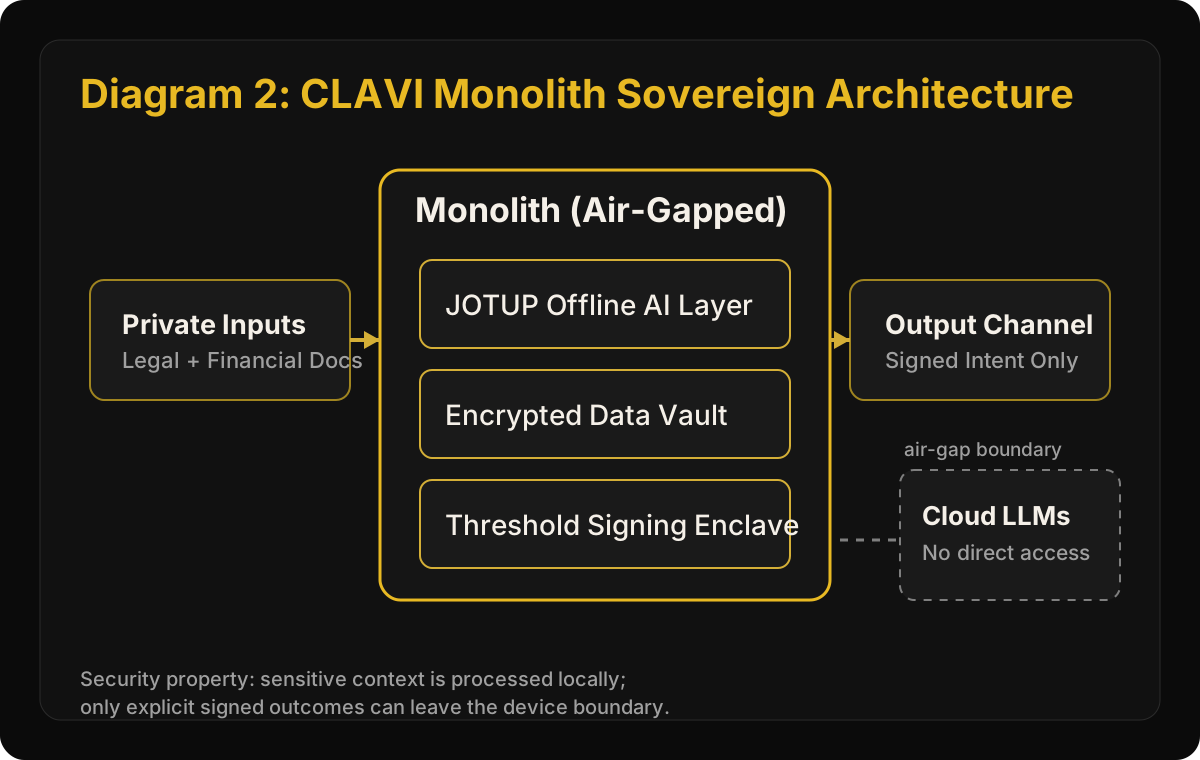
Each requirement addresses a different failure mode. Their integration can reduce risk, but overall assurance still depends on implementation, configuration, recovery and human operations.
5. Succession That Reduces Single-Signer Dependence
Every great family eventually confronts the same quiet terror: the founder who carries the combination in his head, the matriarch whose signature alone unlocks the trust, the individual whose sudden absence would turn a digital estate into a forensic puzzle.
Traditional succession instruments were designed for assets recorded in institutional registries. For solely key-controlled crypto assets with no configured custodian or recovery path, loss or compromise of the only usable key may leave a court order or estate document unable by itself to restore technical access.
Generational crypto succession can use distributed authority, with approvals separated among family members, trustees and locations. That may reduce the impact of one unavailable person or device, but creates participant, coordination and recovery risks of its own. Any time-based or quorum policy needs technical testing, legally valid estate documents and a rehearsed recovery process.
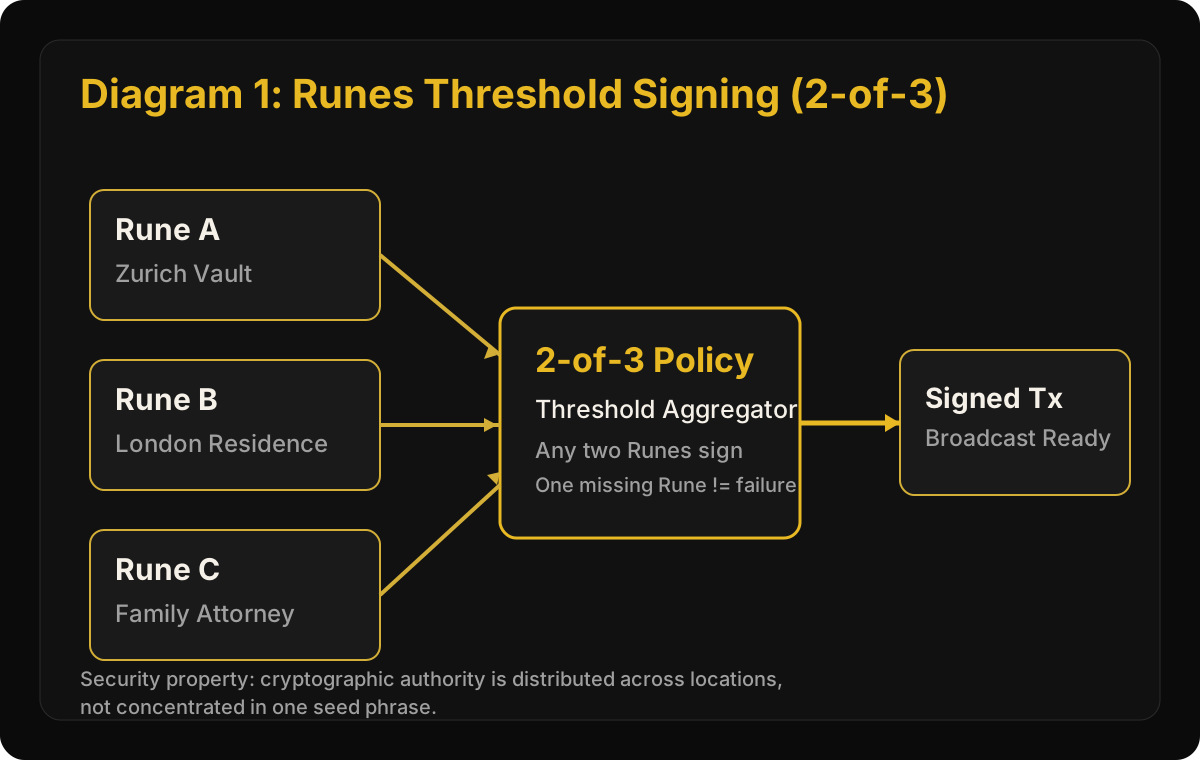
True succession is not a document. It is a system that knows what to do when you no longer can.
This is where the distinction between a custody product and a Personal Digital Vault becomes most consequential. For family-office succession planning, the relevant difference is between inheriting a device and inheriting a tested system of authority, recovery and legal instructions.
6. The Jurisdiction Question Nobody Asks Early Enough
There is a question that separates families who have thought seriously about sovereign crypto custody from those who have merely purchased security products: where does the architecture live, and whose laws govern it?
This is not a marketing consideration. It is a load-bearing architectural decision.
The US CLOUD Act [5] can reach provider-controlled data within its legal scope, while Five Eyes participation forms part of the broader jurisdictional context. For a family office, that makes provider access, corporate location and the location of stored records relevant questions. It does not make every system in those countries equivalent or every request automatically valid.
Swiss jurisdiction occupies a structurally distinct position. Article 13 of the Swiss Constitution [4] protects privacy, while the Swiss FADP imposes duties on personal-data processing. Jurisdiction complements architecture: it cannot make records immune from lawful process, and it cannot protect secrets that an operator unnecessarily collects.
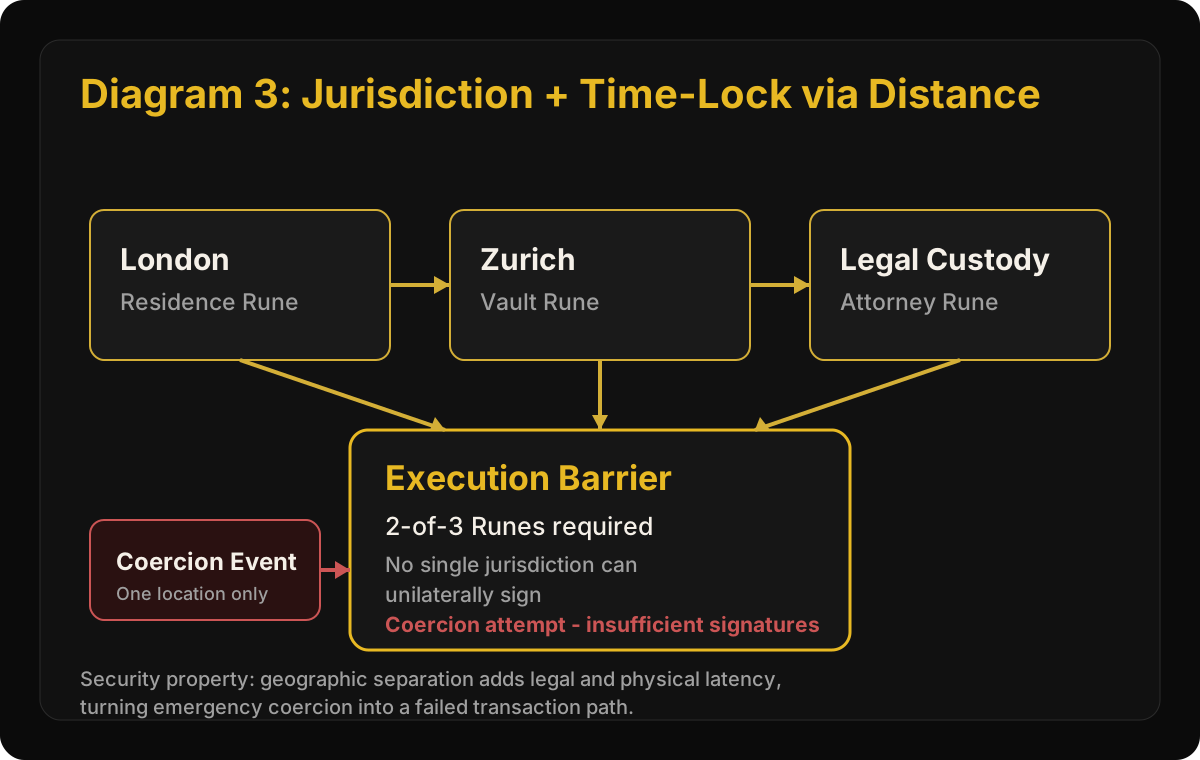
The jurisdiction question asks which rights, duties, remedies and cooperation mechanisms apply to the provider and its records. It is one factor among architecture, contracts, data location and actual operator access.
7. Building the Foundation: From Private Custody to Private Intelligence
Three forces are converging to create a category that did not exist five years ago:
- The limits of centralised custody. Exchange failures exposed counterparty and governance risk. Chainalysis estimated $1.58 billion in stolen-funds inflows through July 2024—84.4% above the comparable 2023 period—while cautioning that its illicit-activity figures are evolving lower-bound estimates [3]. That supports concern about service compromise; it does not show that every category of crypto crime was rising.
- The AI privacy crisis. Cloud AI services process queries on provider-controlled infrastructure and may retain or analyse them under their applicable terms. For a family office using AI for tax strategy or estate planning, local processing can materially reduce that third-party exposure.
- The escalation of physical threats. When digital wealth is concentrated in devices that can be seized, the threat extends beyond the digital. Geographically distributed custody is one possible control, with configuration, recovery and coordination risks of its own.
CLAVI Switzerland AG documents a proposed implementation of this architecture. Its stated approach combines a local node (The Monolith) with biometric authorization devices (Runes) distributed across locations, a zero-knowledge operating system, and the proprietary CLAVI AI, designed for local processing. Production mechanisms and boundaries require engineering verification.
The design philosophy is summarized by CLAVI as “Architecture enforces what policy cannot.” In practice, architecture can enforce only the properties its implementation and configuration actually establish.
CLAVI documents the Monolith as a local node for a home or office and the Runes as components of a proposed distributed approval policy. CLAVI’s stated design objective is to keep protected keys and local AI content outside the operator’s access path. That product boundary is separate from commerce and support records, and its production implementation requires verification. The distinction is examined in CLAVI’s case for data minimization and the comparative architecture in Why CLAVI Isn’t Competing with Ledger.
8. A Final Observation
The question is not whether you trust your custodian. The question is whether your architecture requires you to.
For high-level businesses and families whose digital wealth represents not just capital but legacy, that question is an important infrastructure decision. Families that build and rehearse stronger controls now may be better prepared on a future crisis morning. They will not be unreachable: legal, human, operational and physical risks remain.
An unaudited dependency can be expensive. The practical goal is not to pretend dependencies disappear, but to identify them, reduce them where justified and build tested alternatives for failure and succession.
9. Glossary of Key Terms
Sovereignty. A degree of user control over digital assets, computation and identity. It does not imply freedom from applicable law, dependencies or failure.
Apex Node. CLAVI’s term for a proposed infrastructure platform combining cryptographic authorization, local computation and jurisdiction-aware operation; the deployed properties require verification.
The Monolith. CLAVI’s documented local processing core, intended to isolate supported critical operations from live network and provider-controlled paths. Exact dependencies require version-specific documentation.
The Rune. A hardware authorization device described by CLAVI as using biometric approval within a proposed multi-Rune policy. The production signing mechanism and remaining failure modes require engineering validation.
10. Frequently Asked Questions
Q: What is a Personal Digital Vault? A: A Personal Digital Vault coordinates hardware custody, local processing, permission policy and continuity planning. CLAVI documents a multi-Rune approval design, but whether production uses threshold signatures, multisignature or another quorum mechanism requires engineering verification. Local-first design can reduce reliance on third-party cloud services without proving that every function is independent of them.
Q: How does CLAVI approach crypto succession for family offices? A: CLAVI proposes distributing approvals among Rune devices held by family members or fiduciaries, with documented roles and possible time-based policies. That can reduce dependence on one seed or device, but succession still requires tested recovery, valid estate documents, secure backups and clear procedures; no design guarantees seamless transfer or removes every single point of failure.
Q: Why is Swiss jurisdiction important for digital asset custody? A: Swiss jurisdiction provides constitutional privacy protections under Article 13 and sits outside the Five Eyes alliance. CLAVI’s stated zero-knowledge design aims to keep user secrets outside the company’s reach, which can limit what the operator can disclose. It does not prevent lawful requests for commerce, support, accounting or other records the company actually holds.
Q: What is the custody trilemma in digital wealth management? A: The custody trilemma is a useful way to examine trade-offs among convenience, security and user control. A Personal Vault can combine controls across those dimensions, but it does not abolish the trade-offs or establish complete independence from law, suppliers, software, recovery procedures and human operators.
Q: How does CLAVI’s proprietary AI provide private AI for family offices? A: The proprietary CLAVI AI is designed to run locally on the Monolith so family offices can process sensitive financial, legal and strategic material without sending that material to a cloud-model provider. This local-processing boundary concerns protected vault content; it does not imply that CLAVI Switzerland AG keeps no order, invoice or support records.
11. Works Cited
- Why AI and Crypto Are Gaining Ground in Family Office Portfolios. BNY Wealth. (https://www.bny.com/wealth/global/en/insights/why-ai-and-crypto-are-gaining-ground-in-family-office-portfolios.html)
- Skynet Wrench Attacks Report. CertiK. (https://www.certik.com/ko/skynet-report/skynet-wrench-attacks-report)
- 2024 Crypto Crime Mid-Year Update, Part 1. Chainalysis. (https://www.chainalysis.com/blog/2024-crypto-crime-mid-year-update-part-1/)
- Swiss Federal Constitution, Article 13 (Right to Privacy). Fedlex. (https://www.fedlex.admin.ch/eli/cc/1999/404/en)
- CLOUD Act of 2018. U.S. Department of Justice. (https://www.justice.gov/dag/cloudact)
- Samuel Bankman-Fried Sentenced to 25 Years for Multiple Fraudulent Schemes. U.S. Department of Justice. (https://www.justice.gov/archives/opa/pr/samuel-bankman-fried-sentenced-25-years-his-orchestration-multiple-fraudulent-schemes)
Written by 0NE, architect behind CLAVI’s sovereignty platform. For a deep dive into how bespoke hardware reflects status signalling, see The Two Faces of the Coin. For CLAVI’s proposed distributed approval model and its verification caveats, see Why CLAVI Isn’t Competing with Ledger.