Jurisdiction as a Service: Why Swiss Law Is a Layer in Our Tech Stack
A technical analysis of why jurisdiction belongs inside the sovereignty stack, not outside it.
Updated March 6, 2026.
1. Executive Summary: Jurisdiction Is a Stack Layer
For sovereign hardware, jurisdiction is not a corporate detail. It is part of the security boundary. Cryptography secures data against technical adversaries. Jurisdiction secures data against legal compulsion. If the operator can be forced to extract, retain, or surrender user data under the laws of its domicile, then the relevant vulnerability is no longer the cipher. It is the trust hierarchy around the system.
CLAVI is built on the opposite premise. We treat Swiss jurisdiction as a structural layer that works in concert with ClavOS, the Monolith, and zero-knowledge architecture. The technical goal is non-possession. The legal goal is to operate inside a framework that does not default toward disclosure. Together, those layers create a custody environment designed for digital sovereignty rather than custodial convenience.
| Layer | What it secures | Failure mode if absent |
|---|---|---|
| Hardware | Physical key isolation and signing authority | Keys collapse into a single device or recoverable backup |
| Operating system | Remote access minimisation and local control | The vendor or attacker inherits software-level reach |
| Jurisdiction | Protection against operator-side compulsion | The operator may be forced into disclosure or retention |
| Zero-knowledge design | Technical non-possession of user secrets | The operator remains inside the information flow |
This analysis explains why CLAVI selected Schaffhausen, why Article 13 and the revFADP matter, and why the strongest legal defense is still a technical one: the mathematical inability to comply.
2. The Limits of Cryptography
Encryption is necessary, but it is not sufficient. If a provider can access, recover, log, or reconstruct user data, then the decisive risk is legal and organizational, not cryptographic.
This is the hidden weakness in cloud-dependent systems. Even where transport encryption is robust, the operator still sits somewhere inside the compliance perimeter. For critical assets, family-office treasury, private communications, or proprietary AI workflows, the relevant question is not simply, “Is this encrypted?” It is: “Who can be compelled, under which laws, to produce what they know?”
That is why sovereign hardware cannot be evaluated only by key storage, chip choice, or signing flow. It must also be evaluated by the legal environment surrounding the manufacturer and operator. A system that routes sensitive operations through provider-visible infrastructure inherits a second-order vulnerability: the vulnerability is not in the algorithm, but in the operator’s position in the hierarchy.
For a deeper technical framing of that distinction, see Why CLAVI Isn’t Competing with Ledger.
3. Why Switzerland Is Load-Bearing in the CLAVI Architecture
CLAVI is engineered and incorporated in Schaffhausen, Switzerland because the legal environment must reinforce the same design logic as the hardware. Zero-knowledge architecture is strongest when the surrounding jurisdiction also treats privacy as foundational, not conditional.
This is why CLAVI’s Swiss domicile is load-bearing rather than ornamental. The company sits outside the European Union and outside the Five Eyes intelligence-sharing alliance. That matters because it changes the legal assumptions surrounding operator obligations.
For a sovereign hardware company, domicile is not a branding choice. It is part of the operating environment in which all trust assumptions are evaluated. The legal perimeter must point in the same direction as the hardware perimeter. Otherwise the architecture is internally contradictory: the product may promise sovereignty while the company remains embedded in a disclosure-first framework.
CLAVI’s position is simpler than that. The architecture enforces what policy cannot. Swiss jurisdiction is one of the layers that makes that statement coherent.
4. Article 13 Makes Privacy Constitutional
Article 13 of the Swiss Federal Constitution treats privacy as a fundamental right. That matters because privacy is placed inside the legal architecture of the state itself, not treated as a revocable product policy. [1]
At the systems level, that constitutional baseline changes the posture of the environment in which CLAVI operates. Privacy is not framed as a feature toggle, a terms-of-service clause, or a compliance patch. It is embedded in the legal substrate.
For a company building sovereign infrastructure, that distinction is material. It means the legal framework is structurally more compatible with the product objective of minimizing third-party access to user secrets. The point is not that jurisdiction replaces engineering. The point is that a sovereignty architecture becomes stronger when the legal environment does not work against it.
This is one of the central differences between privacy as messaging and privacy as architecture.
5. The revFADP Aligns with Privacy by Design
Since September 2023, the revised Federal Act on Data Protection (revFADP) has reinforced privacy by design and individual accountability for data protection violations. For CLAVI, this legal logic maps directly onto the product logic. [2]
CLAVI’s architecture is designed to reduce the amount of sensitive information that exists at the operator layer in the first place. That is what privacy by design means at the hardware level: fewer retained secrets, fewer exposed interfaces, fewer paths to compelled disclosure.
The revFADP is therefore relevant not because CLAVI relies on legal promises instead of engineering, but because the legal framework rewards the same discipline the architecture already imposes. A system designed around non-possession is more aligned with a regime that takes data handling seriously than with one that treats disclosure risk as a manageable cost of doing business.
For family offices and sovereignty-focused operators, that alignment matters. The legal layer and the technical layer do not perform the same job, but they do reinforce the same outcome.
6. The Reporting Era Makes Non-Possession More Important
On January 1, 2026, Switzerland adopted the OECD’s Crypto-Asset Reporting Framework (CARF), underlining a broader reality: centralized actors are increasingly expected to retain structured information about client crypto holdings. [3]
This is the jurisdictional paradox of modern custody. The more a provider knows, the more it can be required to store. The more it stores, the more it can be subpoenaed, breached, reported, or operationally exposed.
That is why CLAVI’s model is not built around defending a large operator-side data repository. It is built around shrinking or eliminating that repository in the first place. Because CLAVI employs a strict zero-knowledge architecture, CLAVI Switzerland AG does not sit on a centralized database of user keys, user balances, or local JOTUP prompts.
By contrast, cloud-based custody or intelligence systems can inherit broader disclosure and reporting exposure simply by remaining inside the information flow, including under frameworks such as the U.S. CLOUD Act. [4] The technical question is therefore inseparable from the jurisdictional one: how much sensitive knowledge is centralized, where is it held, and under which laws can it be reached?
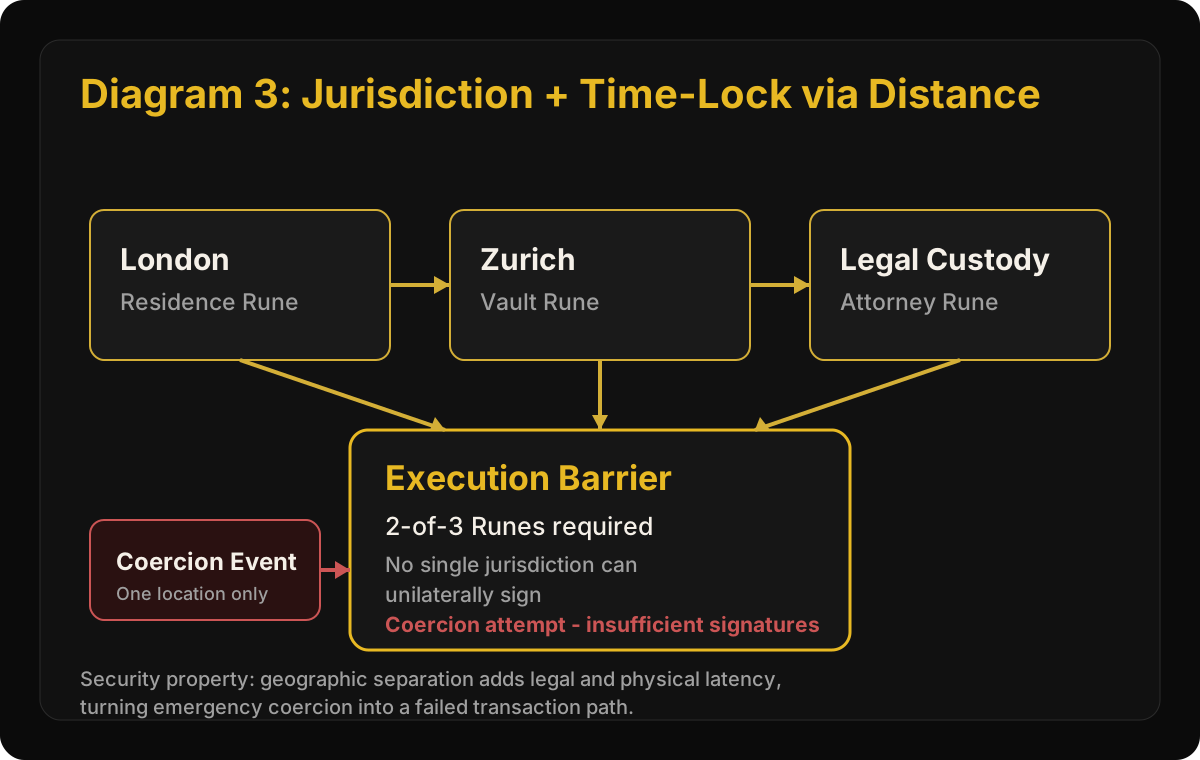
7. Zero-Knowledge Architecture Turns Legal Requests into Technical Non-Events
The strongest legal defense is non-possession. If the operator does not hold the keys, prompts, or recoverable user secrets, then even a lawful request cannot produce disclosure beyond the operator’s actual knowledge.
That is the operating logic of CLAVI.
ClavOS, the Monolith, and the Rune model are built so that CLAVI Switzerland AG maintains:
- zero remote access to client systems,
- zero persistent telemetry on critical user operations,
- zero visibility into private keys,
- zero visibility into local JOTUP prompts and outputs at the operator layer.
This is where the technical and legal layers compound:
- The legal layer: Swiss constitutional privacy protections and the revFADP raise the threshold for intrusion. [1][2]
- The technical layer: CLAVI is designed so the operator cannot retrieve what it does not possess.
- The operational layer: local validation, hardware-enforced signing, and distributed authority keep sensitive execution outside provider-visible infrastructure.
That is the meaning of jurisdictional hardening. Jurisdiction is not replacing cryptography. It is protecting the same sovereignty model from the legal side.
For a broader continuity and estate-planning perspective, see CLAVI: Building a Personal Digital Vault for High-Level Businesses and Families.
8. Documented Glossary of Technical Terms
To keep the argument precise, four terms matter:
- Trust Hierarchy: the chain of delegated authority inside a digital system. Sovereignty begins where that chain terminates.
- Zero-Knowledge Architecture: a design in which the operator has zero access to user keys, data, or operational intelligence by construction, not by promise.
- Swiss Jurisdiction: the legal environment in which Article 13 and the revFADP reinforce privacy as a structural right.
- Jurisdictional Hardening: the practice of selecting and designing for a legal environment that supports the same sovereignty model enforced by the hardware.
These are not adjacent ideas. They describe different layers of the same stack.
9. Frequently Asked Questions
Q: Why does jurisdiction matter if the system is already encrypted?
A: Because encryption protects against technical extraction, not operator-side legal compulsion. If the operator can access, retain, or reconstruct user data, jurisdiction determines what that operator may be forced to disclose.
Q: Does Swiss jurisdiction replace zero-knowledge architecture?
A: No. Swiss jurisdiction and zero-knowledge architecture solve different parts of the same problem. Jurisdiction governs legal exposure; zero-knowledge architecture governs what the operator can technically access.
Q: Why is Swiss law relevant to sovereign hardware specifically?
A: Sovereign hardware is not only about where keys are stored. It is also about which legal system surrounds the manufacturer, operator, and support structure. For CLAVI, Swiss law reinforces the same privacy logic that the hardware and operating system are built to enforce.
10. Works Cited
- Swiss Federal Constitution, Article 13 (Right to Privacy). Fedlex. (https://www.fedlex.admin.ch/eli/cc/1999/404/en)
- Revised Federal Act on Data Protection (revFADP). Federal Data Protection and Information Commissioner (FDPIC). (https://www.edoeb.admin.ch/edoeb/en/home.html)
- Crypto-Asset Reporting Framework (CARF). OECD. (https://www.oecd.org/tax/exchange-of-tax-information/crypto-asset-reporting-framework-and-amendments-to-the-common-reporting-standard.htm)
- CLOUD Act of 2018. U.S. Department of Justice. (https://www.justice.gov/dag/cloudact)