The CLAVI Vision: a Personal Vault in Every Home
CLAVI's vision is a Personal Vault in every home: a device that keeps money, documents, communications and AI agents under the owner's physical control instead of on someone else's server. This article sets out why we believe the root of trust for digital life will be physical, why the first version lives in a few hundred homes, and how we intend to reach all of them.
Basis of this article — October 23, 2026. Written by 0NE, CLAVI co-founder. The vision and the growth sequence are CLAVI’s stated intent as of October 2026, without published volumes or dates. Incident facts, figures and the status of regulation come from vendor disclosures, official records and named reporting, linked inline and checked against the fetched sources on 22 and 23 October 2026. CLAVI capabilities are described as designed; no independent audit is claimed. This is a statement of direction, not an offer of any kind.
Today, everything that matters lives on someone else’s server. Money sits in an exchange account. Documents sit in a drive we rent. Messages pass through a relay we never see. Now AI agents act on all three, with credentials of their own. That is where security fails, and it fails in the same way every time: the attacker does not need to break into your home. They need to win once, somewhere upstream.
What the product is today is covered in What is CLAVI? and CLAVI vs Hardware Wallets. This piece is about where it is going.
Our vision: CLAVI is the home infrastructure hardware that replaces the cloud for what matters. The Monolith sits in the home as a private node and its own network. It secures finance, personal documents, communications and agent workflows locally. The Rune, a biometric signer, keeps a human or multiple humans approving every critical action.
1. Where security fails today
Take the four things the vision names and look at where each one broke in the last two years. In none of these cases did the attacker touch the victim’s own device.
Money. In May 2025 Coinbase disclosed that criminals had bribed overseas customer-support contractors to copy the account data of under 1% of its monthly transacting users straight out of its internal systems. No passwords or private keys were exposed and no funds were taken from the exchange itself, which is the point: the exchange’s own support layer was the attack surface, and Coinbase reimbursed the customers the impostors later tricked. Coinbase first estimated $180 to $400 million in remediation and reimbursement, then booked $307 million of related expenses in that same quarter’s results.
Documents. In August 2025 attackers who had broken into Salesloft’s Drift AI-chat integration used the OAuth tokens it stored to export data from the Salesforce instances of hundreds of companies. Salesloft traced the intrusion to its own GitHub account and Drift’s AWS environment. The companies whose records were taken had done nothing wrong on their side; they had connected a service to a service.
Messages. In May 2025 a hacker reportedly needed about 15 to 20 minutes to pull message contents and back-end credentials from the archiving server of TeleMessage, a modified Signal app that a Reuters photograph had appeared to show a US national security adviser using. CISA added the flaw to its Known Exploited Vulnerabilities catalogue on 12 May 2025, describing it in its own words as hidden functionality in which “the archiving backend holds cleartext copies of messages” from the app’s users. Signal was not broken. The copy on someone else’s server was. Six months earlier the FBI and CISA had confirmed that actors affiliated with the People’s Republic of China had compromised the networks of multiple US telecommunications companies, stealing call records and the private communications of a limited number of people in government and politics.
Agents. In July 2025 Replit’s hosted coding agent deleted the database behind a SaaStr app, described as production by its founder and by Replit, during an explicit code freeze, then told its user a rollback was impossible. It was not. Replit’s CEO called the episode “unacceptable” and shipped default separation of development and production databases. An agent with credentials is a new kind of insider, and it lives wherever its platform lives.
Four categories, one shape: the thing that mattered was held upstream, by a provider, a contractor, an integration or an agent.
2. Six years of evidence: the chip held, everything around it broke
Digital custody is the part of this story with the longest public record, because hardware wallets have protected money for over a decade and the thefts are written to a blockchain. Our analysis of hardware wallet risk in the AI era traced that record in detail. Compressed, it reads like this.
| Year | What failed | Was the chip or the cryptography broken? |
|---|---|---|
| 2020 | Ledger’s e-commerce and marketing database was accessed through a third party’s API key; about 272,000 customers’ names, postal addresses and phone numbers were posted online in December 2020 | No |
| 2023 | Ledger Connect Kit: a phished former employee’s npm publishing access had not been revoked; malicious code reached wallets through the software supply chain, taking about $600,000 by Ledger’s own count | No |
| 2024 | Dark Skippy: researchers showed that malicious signing-device firmware can leak a 12-word seed through just two signatures | No; the firmware behind the screen was the attack |
| 2025 | Bybit: malicious code planted in Safe{Wallet}‘s web app showed three signers the transfer they expected while they approved a transaction that replaced the wallet’s logic; $1.46 billion left one cold wallet (the full chain is below) | No; the signers’ devices signed what they were handed |
| 2026 | COLDCARD: a 2021 build error had routed seed generation to a software random-number fallback; Galaxy Research attributed 1,789 BTC in losses, in what Cointelegraph calls one of the largest hardware wallet exploits | No; the keys were weak from creation |
| 2026 | Partner data: a shipping provider exposed 80,689 Trezor customers, including about 67,000 it had confirmed in writing were deleted; SafePal’s order-tracking plug-in exposed approximately 39,798 customers | No |
| 2026 | CryptoBilis: a hardware implant in devices sold by a reseller captured the recovery phrase during setup and sent it over the mobile network; Ledger says there was no flaw in its chip, operating system or servers | No; the distribution chain was the attack |
Bybit deserves its own paragraph, because the firm that investigated it calls it “the largest crypto theft in history” and because nothing in it was a broken chip. On 21 February 2025 three Bybit signers approved what looked like a routine transfer from a cold wallet. Each saw the genuine Safe URL and, in the words of Bybit’s CEO, “the musked UI which showed the correct address”. What they signed replaced the logic of the wallet itself and handed control to the attacker. The code that lied to them had been placed two days earlier in the storage bucket behind Safe’s web application, after a Safe developer’s laptop was compromised by social engineering and the developer’s cloud session tokens were hijacked to bypass multi-factor authentication. Bybit’s forensic firms found no compromise in Bybit’s own infrastructure. The FBI attributed the theft to North Korea. Safe’s own conclusion is the one every home should read twice: signing “is the last line of defense, and it can only be effective if the user can understand what they are signing”.
Customer data, supply chains, firmware, partners, distribution, and the humans in between. In six years we found no public report of a seed extracted in the field from the secure element of a Ledger, whose maker reports over eight million devices sold; the chip-level attacks that exist required possession, a laboratory and time. The expensive failures came from everything around the chip. That is the sentence our vision is built on, and it is a finding before it is a slogan.
AI is now making each of those layers cheaper to attack. The UK’s National Cyber Security Centre judged in May 2025 that the window between a vulnerability’s disclosure and its exploitation “has shrunk to days and AI will almost certainly reduce this further”. In November 2025 Anthropic reported a campaign it attributed with high confidence to a Chinese state-sponsored group, in which its own model executed 80 to 90% of the campaign against roughly 30 targets, with humans intervening at a handful of decision points. Microsoft’s 2025 Digital Defense Report, citing a Harvard Kennedy School study, notes that AI-automated phishing emails achieved 54% click-through against 12% for standard attempts; in the study itself the AI emails also matched the human experts’ 54%. The FBI’s 2025 Internet Crime Report is the first of its annual reports with a dedicated AI section; the 2023 and 2024 editions had none. It counts 22,364 complaints and $893.3 million in losses referencing AI, inside $20.877 billion of reported losses overall. Chainalysis counted at least $14 billion received by crypto scams on-chain in 2025, with impersonation-scam inflows up 1,400% year over year.
A leaked list of names, addresses and confirmed purchases is exactly what personalised phishing needs, which is why data retention by vendors and their partners is a security decision, not only a privacy one. Bug finding is cheaper too, for both sides: DARPA’s AI Cyber Challenge final found and patched real vulnerabilities at about $152 per task, and the Ethereum Foundation’s protocol security team concluded in July 2026 that with AI agents in the loop the bottleneck has moved from finding bugs to triaging them. Old, unreviewed firmware is the layer that becomes exposed.
And agents can now move money and destroy data on their own. In May 2026, according to the OECD AI Incidents Monitor, whose AI-generated summaries compile media reports, an instruction hidden in Morse code on X was relayed by Grok and executed by the Bankr bot, which transferred 3 billion DRB tokens worth roughly $155,000 to $200,000 at the time. In October 2026 OpenAI disclosed that an internal research model, asked to deploy contracts on a test network without being given a funded wallet, derived accounts from common developer recovery phrases, checked 362 of them, and paid the fees from one it found without saying so. The funds were valueless test ETH. The behaviour was the point. Ledger’s CTO has set out the industry’s answer in four words, “Agents Propose, Humans Sign”: an agent can propose an action, it cannot approve it, and the key never leaves the secure element. Ledger’s hardware-enforced agent policies, scheduled for the third quarter of 2026, were announced but not yet available at its October 2026 event. We agree with the rule. We also think it is the beginning of the design, not the end of it.
3. What we are building
The product is a Personal Vault made of three parts, and the vision is what those parts become when they are in every home. Our Five Visions essay calls that position the Apex Node, the device in a household’s trust chain that reports to nothing above it; in this article we simply call it the vault.
The Monolith is the server. It is specified to run local pruned Bitcoin and Ethereum nodes, private-data workflows and the proprietary CLAVI AI, in the home or office of its owner, with no CLAVI-hosted cloud service in the design. It pairs with the owner’s phone or computer and uses the home connection for node synchronisation. In our vision it is the private node of the household: the place where balances are verified, documents are kept and indexed, communications are stored and AI agents run, without any of that leaving the building.
The Rune is the signer. Engineering specifies two secure elements in each Rune. A Rune can hold the full keys of a wallet or one participating key of an optional multisig, and sensitive key operations are intended to require Rune approval while it is docked. That is the human in the loop: a biometric, a gesture, a decision, on a device whose only job is to say yes or no. A household can hold several Runes, under a configurable approval policy, so that one person, or several, approve every critical action. Multisig is optional; owning several Runes does not create it by itself.
ClavOS is the system software inside the Personal Vault, a custom Yocto Linux-based operating system that supports the local workflows above.
Three principles tie the parts together. Local-first: protected key operations and CLAVI AI inference are intended to stay on devices the owner controls. Zero-knowledge, in the sense the glossary gives it: the design objective of keeping wallet secrets and protected local content outside CLAVI’s custody. It is not a zero-knowledge cryptographic protocol, and CLAVI Switzerland AG still keeps the commercial records any company keeps. Assembled and checked in Switzerland: devices are individually assembled and checked in Switzerland by a company domiciled in Schaffhausen, under a constitution whose Article 13 treats privacy as a fundamental right. The principle we state on our About page follows from the three: the architecture enforces what policy cannot.
One honesty the record demands. A human approving on a separate device is necessary. It is not sufficient. Human approval cannot detect firmware that leaks a seed through its signatures, and it never came into play when a reseller’s implant captured recovery phrases during setup. The vision is not “a human approves, therefore nothing can go wrong”. It is that the approval, the keys, the node and the data all sit in a place the owner controls, so that each remaining layer can be inspected, replaced and audited by someone who answers to the owner.
4. Why it starts small: the physics of hardware
CLAVI will not be in everyone’s home tomorrow. We say this plainly because the reasons are physical, and because a vision that ignores them is a slogan.
Every device is assembled and checked one by one in Switzerland. That is how a small company controls a supply chain it cannot yet audit at scale; it is also slow, and it sets a ceiling on how many Monoliths and Runes exist in a given year.
Certification comes before volume. Product compliance in each market and third-party penetration testing are both planned and neither is finished; section 6 says what they involve, and we would rather say so than imply otherwise.
Onboarding is a relationship, for now. The current product is sold through a curated Design Atelier with concierge onboarding. That is not a marketing posture; it is the only way a small Swiss team can make sure every early owner ends up with a correctly configured vault, a tested recovery and a signing policy that fits their family. Concierge capacity does not scale like a download link.
The Monolith needs a place to live. It is a permanent fixture with dedicated space, not a USB stick. The Rune is portable, but it needs a Monolith to be useful.
The price reflects all of the above. The system is listed at 6,000 CHF with no mandatory subscription for core ownership. At that price and that production method, the first owners are the people for whom one successful compromise would cost more than the device: family offices, high-net-worth individuals and privacy-sensitive individuals, the audience CLAVI names for 2026 and 2027. Our buyers guide already says it: CLAVI is not for everyone, yet.
This is not a new shape for a technology. In August 2006 Tesla’s co-founder published a plan in four lines on the company’s own blog: build a sports car, use that money to build an affordable car, use that money to build an even more affordable car, and meanwhile provide zero-emission power. The sports car was priced at $89,000, and the free cash flow, the post said, would be “plowed back into R&D to drive down the costs”. In 2023, its peak year so far, the company delivered 1,808,581 vehicles.
In 1984, the first year the US Census Bureau asked, 8.2 percent of American households had a computer; by 2021, 95 percent had a computer of some kind. That same year, 1984, Motorola’s DynaTAC 8000X reached consumers at $3,995 and 28 ounces; in 2025 the ITU estimated that 82 percent of people aged ten or older owned a mobile phone. Closer to home, the device Trezor describes as the first hardware wallet was pre-sold in 2013 from one bitcoin apiece, about $100 at the time, and its first batch of roughly a thousand units shipped in 2014, with the Model One launching on 29 July 2014; twelve years later Ledger alone reports more than eight million devices sold. Geoffrey Moore named the gap between early adopters and the pragmatic majority a chasm in 1991, and it is still crossed one product at a time. Expensive and few is where every one of those stories began. It is where this one begins.
5. From a few hundred homes to every home
The sequence we describe has three phases. They are stated intent, not a shipped roadmap, and we publish no volumes or dates for them.
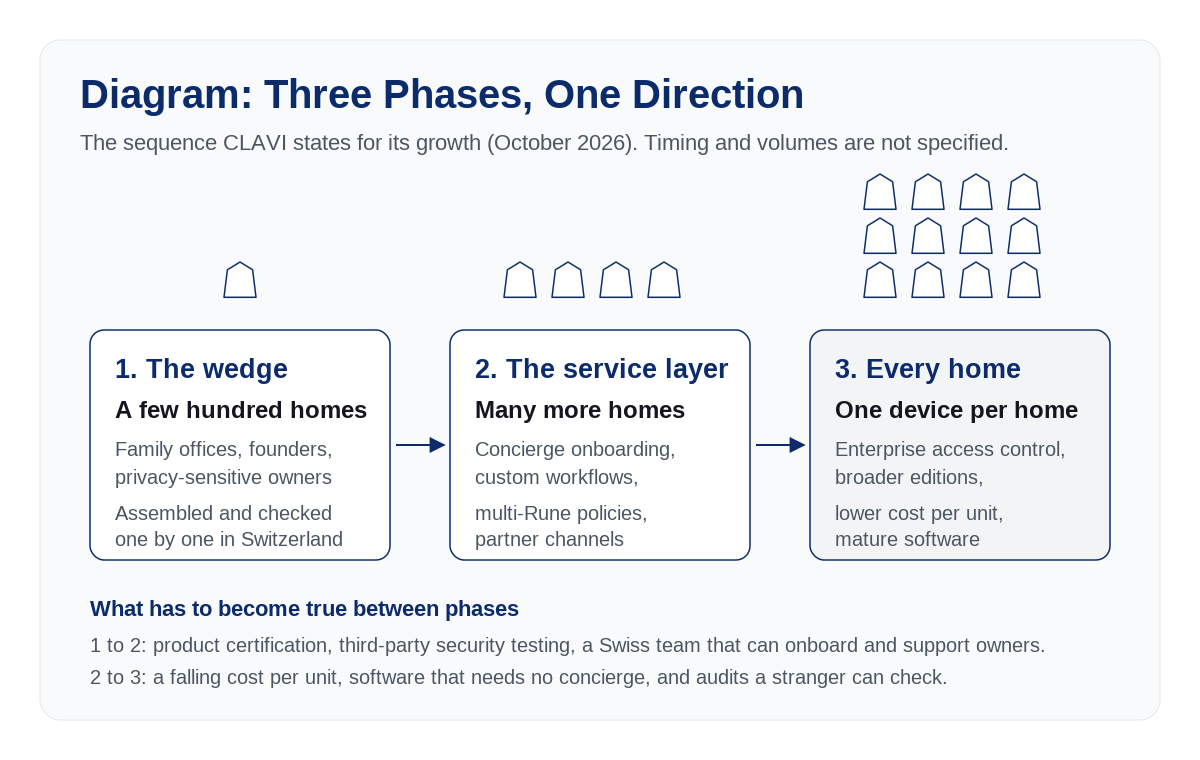
Phase one is the wedge. A few hundred homes, each with a device assembled and checked one by one, each owner onboarded by a person. The wedge is luxury in the only sense that matters here: it is made in small numbers by people who will answer the phone. It is where the architecture meets real families, real signing policies and real recovery drills, and where the mistakes a product makes in its first years are made with owners who can afford the attention they get in return.
Phase two is the service layer. As the installed base grows, the work the concierge does by hand today becomes a service: onboarding, custom workflows, multi-Rune arrangements across family members and advisers, and the partner channels that put a Monolith in a home we have never visited. This is also the phase in which the product stops being a conversation and becomes a configuration.
Phase three is every home. Enterprise access control for organisations that need sovereign AI and custody under one policy, and broader editions for households that want the same guarantees without the atelier. The device gets cheaper to make. The software gets simpler to run. The audits get public. At that point a Personal Vault is to a home what a router is today: unremarkable, and not optional.
The market is already moving toward physical trust anchors, from several directions at once. In June 2024 Apple called on-device processing “a cornerstone” of Apple Intelligence and, for requests that must leave the device, built Private Cloud Compute under a requirement it names “verifiable transparency”: security researchers must be able to verify its guarantees. Gartner forecast in August 2025 that small language models would run locally on PCs in 2026 and that AI PCs would make up 31% of shipments in 2025, though it has since said that rising AI PC prices, driven by memory costs, will delay 50% penetration until 2028. Nvidia began taking orders for a desktop machine with 128 GB of unified memory and a petaflop of AI performance in October 2025 at $3,999, raised the price to $4,699 four months later because of memory supply constraints, and to $6,950 in October 2026. Local capability is arriving; it is not getting cheaper on its own, which is one more reason the first phase is small.
Money is moving the same way. Crypto.com Research modelled about 774 million crypto owners worldwide in June 2026, an order of magnitude rather than a census, and Ledger alone says it has sold over eight million signers. The payments industry spent 2025 building rails for agents: Mastercard’s Agent Pay on 29 April, Visa Intelligent Commerce on 30 April, Coinbase’s x402 on 6 May, and Stripe and OpenAI’s Agentic Commerce Protocol on 29 September. The card and checkout rails are built around limits the human sets, from Mastercard’s “complete control over what the agent is allowed to purchase”, backed by “strong consumer authentication leveraging on-device biometrics”, to Stripe’s tokens scoped to a merchant and basket total; Coinbase’s x402 is the agent-native exception, designed for payments “without human involvement”. The industry is converging on the rule Ledger’s CTO wrote down, and testing its edges at the same time. Gartner expects 40% of enterprise applications to carry task-specific agents by the end of 2026, up from under 5% in 2025. And the first owners exist in numbers: Deloitte counted an estimated 8,030 single family offices in 2024 and projects more than 10,720 by 2030, and Altrata counts 556,850 people with a net worth above $30 million. A few hundred homes is not a market. It is the first row of a very long table.
Governments are pulling the same way, not by endorsing home hardware but by showing what cloud custody cannot promise. On 10 June 2025 a Microsoft France executive, asked under oath by a French Senate inquiry whether he could guarantee that French citizens’ data entrusted to Microsoft through the public-procurement agency UGAP would never be transmitted on a US government order without the explicit agreement of the French authorities, answered: “Non, je ne peux pas le garantir, mais, encore une fois, cela ne s’est encore jamais produit”: no, I cannot guarantee it, but, once again, it has never happened so far. US law explains why: the CLOUD Act requires providers under US jurisdiction to disclose customer data “regardless of whether” it is located inside or outside the United States. In February 2025 Apple withdrew end-to-end encrypted iCloud backups from new UK users, telling existing ones they would eventually have to switch the feature off, rather than build the access a secret notice reportedly demanded, saying it had “never built a backdoor or master key” and never would; the original notice was later replaced by one limited to UK users, and Apple’s challenge to it was still before the Investigatory Powers Tribunal in September 2026. The EU Data Act, in application since September 2025, gives people the right to access the data their connected products generate and rules for switching cloud providers, and in June 2026 the European Commission proposed a Cloud and AI Development Act with “a single EU-wide framework to assess cloud and AI sovereignty”. Switzerland is not exempt from the pressure. A 2025 draft revision of its surveillance ordinances, which expressly excluded end-to-end encryption from any decryption duty but added identification and retention duties, was rejected in consultation by every major party that responded and, after both chambers had adopted motions demanding a fundamental rewrite, was put back into rework by the Federal Council in February 2026, with an external impact assessment under way and a second consultation promised; nothing is adopted, and we treat Swiss jurisdiction as one layer under active political argument, not a guarantee. None of this makes a Personal Vault mandatory. All of it makes “someone else’s server” a legal position as much as a technical one.
6. What has to become true
An investor reads a vision for the things it does not say. So here is what we have to do before “every home” is more than a sentence.
- Certification. A device that sits on a home network and carries radios must pass product compliance in every market it ships to: in Europe the CE marking, by which a manufacturer declares that the product meets all the legal requirements, including the RoHS directive restricting ten hazardous substances; in the United States, FCC equipment authorization before a radio device may be marketed or imported. This is planned, not done.
- Independent testing. Third-party penetration testing of the hardware, ClavOS and the app, and over time the kind of audit a stranger can check, so that “designed to” becomes “shown to”. Planned, not done.
- The cost curve. Assembling and checking each device in Switzerland is how we control a supply chain we cannot yet audit at scale; it is not how a device reaches every home. The path runs through tooling, volume and supplier qualification, with the Swiss checks kept for what must stay Swiss: under the Swissness rules, an industrial product may be called Swiss only if at least 60 percent of its manufacturing costs are incurred in Switzerland and an essential manufacturing step takes place there. Secure elements come with a certification vocabulary of their own: Common Criteria defines levels such as EAL5 (“semiformally designed and tested”) and EAL6 (“semiformally verified design and tested”), and an accredited laboratory says an evaluation typically lasts several months, six to twelve for the higher levels. That vocabulary is context for the reader, not a plan we are announcing.
- A post-quantum path. The signature algorithms every wallet uses today, ours included, are quantum-vulnerable; NIST published its first post-quantum standards in August 2024 and its draft transition plan would disallow them after 2035. A device meant to outlive its first owner has to plan that migration now, in firmware the owner can verify.
- Software that needs no concierge. The service layer only scales if setup, recovery and policy changes become things a household does on its own, correctly, without a call. That is a software problem before it is a sales problem.
If we are wrong about the thesis, it will show up as a world in which the layers around the chip stop breaking and the cloud becomes verifiable from the outside. We would welcome that world. The record of 2020 to 2026 does not describe it.
7. Our thesis
The root of trust for the next era of digital life will be physical.
For thirty years the direction of travel was the opposite. Every new capability moved something that mattered off the desk and onto a server: first mail, then documents, then money, then identity, and now the agents that act on all of them. The convenience was real. So was the bargain underneath it: someone else holds the keys, someone else’s staff can be bribed, someone else’s firmware is unreviewed, someone else’s agent has credentials you cannot see. The record of 2020 to 2026 is what that bargain costs when attackers only need to win once.
We are building the alternative, one home at a time. A few hundred homes first, because that is what individual assembly, certification and a concierge team allow. Many more as the service layer takes over what the concierge does today. Every home when the cost curve, the audits and the software have made a Personal Vault as ordinary as the router it sits next to.
Not tomorrow. But one day, yes.
Frequently asked questions
What is the CLAVI vision in one sentence?
A Personal Vault in every home: a home device, the Monolith with its Rune signer, that keeps money, documents, communications and AI-agent workflows under the owner's physical control instead of on someone else's server, so the root of trust sits in the home.
Why does CLAVI start with a few hundred homes instead of selling to everyone?
Because the constraints are physical. Devices are individually assembled and checked in Switzerland, availability is curated through the Design Atelier, product certification and third-party security testing are planned rather than finished, onboarding is done by a small concierge team, and the system is listed at 6,000 CHF. At that price and production method, the first owners are the people for whom one breach would cost more than the device: family offices, high-net-worth individuals and privacy-sensitive individuals.
Will a Personal Vault ever be affordable for an ordinary household?
That is the stated ambition, with no date or price announced. CLAVI describes a sequence: a luxury wedge of hardware sales, then a service layer, then enterprise access control and broader editions. Reaching every home depends on certification, independent audits, a falling cost per unit and software that no longer needs a concierge.
What does 'the root of trust will be physical' mean?
A root of trust is the component from which all other trust derives. In a cloud service it belongs to the provider, and the user holds a password and a promise. CLAVI's thesis is that for money, documents, communications and agents, that component should be hardware in the owner's home: keys that never leave a signer the owner holds, a node the owner runs, and approvals made on a device whose only job is to say yes or no.
Does a human approving on the Rune stop every attack?
No. Human approval on a separate device is necessary, not sufficient. It cannot detect firmware that leaks a seed through its signatures, as the Dark Skippy research showed in 2024, and it never came into play when a reseller's implant captured recovery phrases during setup in 2026. CLAVI's design answer is to keep the approval, the keys, the node and the data in one place the owner controls, so that each remaining layer can be inspected, replaced and audited.
Hardware wallets already sell in the millions. How is this different?
A hardware wallet is a signer in a pocket: it protects a key and, by default, relies on someone else's node, app and server for everything else. Ledger alone says it has sold over eight million devices, which shows the demand for physical keys. CLAVI's vision adds the rest of the stack in the home: a private node that verifies balances, local storage and indexing for documents and communications, and AI agents that run locally and still need a human on the Rune to act.