SafePal Data Breach Explained: What the 39,798-Customer Disclosure Means
Research cutoff: August 20, 2026. SafePal’s counts, chronology, affected fields, unaffected categories and remediation statements are vendor-reported and have not been independently audited in public. This article is educational and is not incident-response, legal or financial advice.
The direct answer
SafePal says an authorization flaw in an order-tracking plug-in exposed order information for approximately 39,798 customers. The reported data included names, email addresses, shipping addresses, phone numbers and purchase details. SafePal says seed phrases, private keys, wallet passwords, payment-card numbers and other listed wallet or financial credentials were not involved. That distinction matters, but it does not make the exposure harmless: identity plus purchase context can make phishing and impersonation more convincing.
This is an incident about the commerce-data plane, not a reported compromise of wallet-secret generation or custody. The public record is also still incomplete. SafePal has not published an independent forensic report, a full technical exploit path or a final audit result.
SafePal breach facts at a glance
| Question | Publication-safe answer | Confidence |
|---|---|---|
| When was it disclosed? | SafePal published its disclosure on August 16, 2026, then added an update on August 18. | Publication dates confirmed from SafePal’s own pages. |
| How many customers? | SafePal says approximately 39,798 customers were affected. | Vendor-attributed; not an independently audited total. |
| Which orders? | SafePal says affected customers placed orders from March 2, 2025 through April 11, 2026. | Vendor-attributed order period; not established as the attacker’s access window. |
| What was exposed? | Names, email addresses, shipping addresses, phone numbers and purchase details, according to SafePal. | Vendor-attributed; “purchase details” is not fully enumerated publicly. |
| What was not reported as exposed? | SafePal says seed phrases, private keys, wallet passwords and other wallet credentials, bank-account information, payment-card numbers and government-issued ID numbers were not involved. | Vendor-attributed incident scope. |
| What caused it? | SafePal describes an authorization flaw in an order-tracking plug-in or function. | Vendor-attributed summary; no public technical report identifies the owner, endpoint or complete exploit path. |
| Was a dataset sale confirmed? | No. SafePal said on August 18 that it could not verify claims that individuals possessed or offered the data. | The claims exist; their authenticity remains unconfirmed. |
What SafePal disclosed and what it did not
SafePal’s August 16 statement and longer security update describe a flaw in an order-tracking component that, under certain conditions, allowed unauthorized access to another customer’s order information. SafePal says it remediated the issue after discovery and added security measures.
Reuters reported the disclosure on August 16, confirming that it was public that day. Its incident details still trace to SafePal’s account; the report is not independent forensic validation of the count, fields or remediation.
That wording supports a limited conclusion: an authorization control in the order flow failed. It does not establish which company owned the plug-in, whether the flaw had a public CVE, which endpoint was involved, how access was automated, who accessed it or exactly when access began and ended. Calling it a specific IDOR, a named WordPress vulnerability or a third-party supply-chain compromise would go beyond SafePal’s published evidence.
SafePal reported five exposed data categories:
- Names.
- Email addresses.
- Shipping addresses.
- Phone numbers.
- Purchase details.
The first four categories are clear. “Purchase details” is less precise. SafePal’s pages also use “order details,” but do not publish a field-by-field schema. This article therefore does not infer an exact device model, serial number, order value, wallet balance or government identifier.
SafePal separately says the affected order data did not include seed phrases, private keys, wallet passwords, other wallet credentials, bank-account information, payment-card numbers or government-issued identification numbers. Its incident checker and FAQ also say it found no evidence that the incident itself compromised access to SafePal wallets or funds.
Those are meaningful boundaries, but they are still SafePal’s findings. No public third-party audit result was available by the research cutoff.
The reported chronology
SafePal’s live FAQ provides more chronology than its short announcement. Every point below remains company-attributed:
| Date | What SafePal says happened | What the date does not prove |
|---|---|---|
| Early May 2026 | SafePal says it received a report consistent with the issue, treated it initially as an isolated case, then escalated it into a formal security investigation and added protections. | The public page does not establish the first unauthorized-access date or identify every earlier signal. |
| July 2026 | SafePal says it began a full review and rebuild of its order-processing pipeline and confirmed the disclosed root cause during the investigation. | No public technical report gives the exact confirmation date, test method or complete exploit sequence. |
| August 16, 2026 | SafePal published the disclosure and says it emailed identified affected customers from security@safepal.com. | Public evidence does not independently verify delivery to every affected inbox. |
| August 18, 2026 | SafePal said outside investigation and audit engagement was progressing and that it could not verify dataset-possession or sale claims. | This was an update, not a completed independent audit or proof that a dataset sale occurred. |
The lag between the first reported signal and public disclosure deserves scrutiny. SafePal says the e-commerce stack involved multiple connected components, external integrations and logistics partners, and that the team could not immediately rule out alternative explanations. That can explain investigative complexity, but it does not let an external reader assess whether escalation, containment or notification was timely. A defensible account must preserve both facts: SafePal reports an investigation, and the public record does not provide enough evidence to independently evaluate its speed.
Why a cleanup failure changed the exposure window
SafePal says a scheduled data-cleanup process stopped working correctly between September 2025 and April 2026 because of a configuration error. According to the company, this failure did not cause the unauthorized access; it allowed older order records to remain available and explains why the affected order range reaches back to March 2025.
This is the sharpest data-minimization lesson in the incident. A written retention policy is not a security control unless the deletion job runs, failures alert someone and expired records disappear from every relevant copy. Configuration drift can turn a short-lived fulfillment dataset into a much larger pool without changing the original collection form.
SafePal says it has now shortened retention in the relevant order-processing environment to 90 days, subject to legal requirements. Its FAQ adds two important limits:
- SafePal says a secured offline backup of the specific affected records is being retained for potential investigations.
- Its customer-removal flow says names, emails, shipping addresses and contact numbers can be removed while order number and shipping country remain for warranty and after-sales support.
So “SafePal deletes all customer data after 90 days” would be false. The company describes a narrower active-system period, retained incident evidence and selected warranty fields. It has not published public evidence showing how expiry propagates through replicas, backups, logistics partners or other processors.
Why order data matters when the keys remain protected
Self-custody protects control of assets only if wallet secrets remain secure. It does not automatically conceal who bought a device, where it was delivered or how the buyer can be contacted.
Order data can provide ingredients for a tailored pretext. A fraudulent message that knows the vendor, approximate purchase and real contact details may look more credible than generic spam. SafePal itself warns about possible phone calls, emails, texts, letters, refund offers, firmware-update requests, fake support communications and malicious websites.
That is a statement about risk, not proof that every exposed record has been abused. SafePal says it identified and took down more than 30 fraudulent sites and phishing links tied to scam activity. The public material does not establish that those sites used this dataset, who operated them or whether the data exposure caused any particular financial or physical harm.
The same discipline applies to claims that the customer dataset was offered for sale. On August 18, SafePal said it was aware of such claims but could not authenticate them. Until the advertised records are independently verified, “the dataset was sold” is not a publication-safe fact.
What affected customers can do without trusting an unexpected message
The safest first step is to separate the message from the verification channel.
- Navigate independently. Type SafePal’s official domain manually or use a previously trusted bookmark. Do not use a link, QR code, phone number or reply address supplied by an unexpected message.
- Use the official checker. SafePal provides a page that asks for order ID and shipping country. The existence of the checker is confirmed; its result remains SafePal’s determination.
- Never disclose wallet secrets. SafePal says its staff will not ask for a seed phrase, private key or wallet password. An order-data incident does not create a legitimate reason for anyone to request them.
- Treat real details as untrusted context. A caller knowing a name, address or purchase does not prove the caller is SafePal, a carrier or law enforcement.
- Report suspicious contact through a separately verified channel. SafePal provides a dedicated incident page and support route. The U.S. Federal Trade Commission likewise advises contacting a company through a website or number already known to be real rather than information in the message.
- Escalate an actual secret disclosure. SafePal says that if a customer already entered a seed phrase or private key into a suspicious site or shared it with a caller, that wallet should be treated as compromised and the customer should follow current official recovery guidance. This is different from merely having order data exposed.
- Address physical-safety concerns locally. Anyone who receives a credible threat or has immediate safety concerns should contact local law enforcement or emergency services; a general web article cannot assess an individual threat.
SafePal says customers do not need to replace a device or move assets solely because their order information was affected. That is vendor guidance about this disclosed incident, not a blanket assurance about every device, message or account.
What SafePal says it changed and what remains unknown
SafePal says it fixed the authorization flaw, strengthened access controls, began a full review and rebuild of the order-processing pipeline, reduced the relevant retention window, contacted logistics and fulfillment partners, opened a dedicated support channel and began engaging an independent security firm.
It also says it found no evidence that the authorization issue extended into external logistics systems. That is not the same as an independent clean bill of health from every processor.
As of August 20, the following questions remained open:
- What exact fields are included in “purchase details”?
- Who owned and operated the affected plug-in or function?
- What was the exact access period, request volume and record-access pattern?
- How did SafePal identify the 39,798 records, and could that count change?
- What caused the cleanup configuration failure to persist without an effective alert?
- Which active systems, replicas, backups and subprocessors contain order data, and how is deletion verified?
- What did the independent investigation conclude about root cause, scope and remediation?
- Are any advertised datasets authentic, complete or connected to this incident?
Future vendor updates may answer some of these questions. Until then, the honest label is developing, vendor-attributed scope.
The CLAVI lesson: keep secrets inaccessible and business data purpose-bound
The broader CLAVI data-minimization analysis separates three data lanes:
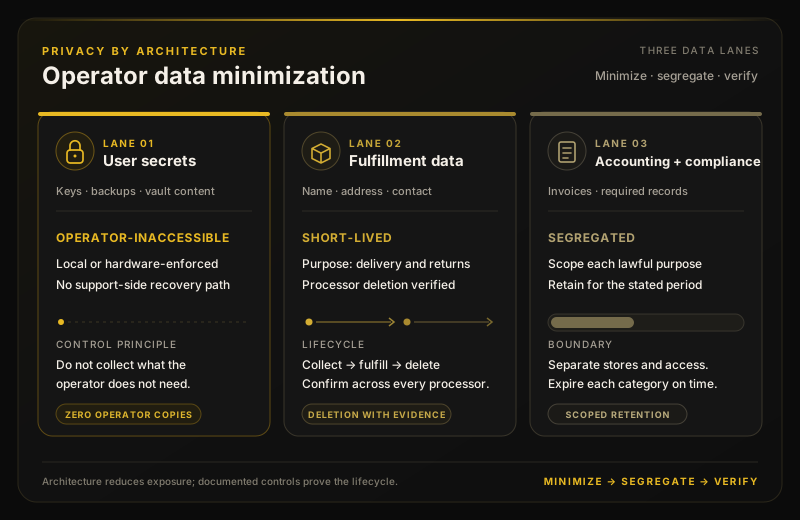
For a Personal Vault, “zero knowledge” should be a precise boundary: the operator should not receive or be able to recover private keys, recovery material or protected vault content. It should not be stretched into a claim that an operating company has no order, invoice, support, warranty or incident records.
The SafePal disclosure shows why the second lane needs its own engineering discipline:
- Collect the smallest fulfillment field set.
- Keep tracking components away from wallet and support systems.
- Assign an expiry at collection and alert on missed deletion jobs.
- Test deletion in active databases, replicas and restore procedures.
- Preserve incident evidence only through a documented, scoped hold with a review date.
- Keep warranty and accounting records separate from delivery addresses and marketing profiles.
- Verify processor deletion rather than assuming a contract performed it.
Less data reduces the blast radius. It does not eliminate authorization bugs, failed cleanup jobs, phishing, processor copies, legal retention or the need for incident response. The practical standard is therefore not a slogan of “no data”; it is no operator access to vault secrets, minimum necessary business data and evidence that each retention rule actually works.
Frequently asked questions
Was SafePal’s wallet technology hacked?
SafePal’s August 16 disclosure described unauthorized access to customer order information through an authorization flaw in an order-tracking plug-in. SafePal says the incident did not compromise access to its wallets or funds and did not involve seed phrases, private keys, wallet passwords or other wallet credentials. Those conclusions remain vendor-reported, not independent audit findings.
How many customers did SafePal say were affected?
SafePal reported approximately 39,798 affected customers who placed orders between March 2, 2025 and April 11, 2026. The company has not described those dates as the attacker-access period. SafePal says a failed cleanup process left older order records in the system and contributed to the long affected order range.
What SafePal customer data was exposed?
SafePal says the exposed order information included names, email addresses, shipping addresses, phone numbers and purchase details. Its public notice does not fully enumerate what the purchase details contained, so claims about exact products, serial numbers, order values or wallet balances would go beyond the published evidence.
Were seed phrases, private keys or payment-card numbers exposed?
SafePal says no. It states that the affected order data did not include seed phrases, private keys, wallet passwords or other wallet credentials, bank-account information, payment-card numbers or government-issued identification numbers. This is SafePal’s reported incident scope rather than an independently published forensic conclusion.
Was the SafePal customer dataset confirmed for sale?
No public evidence reviewed by the August 20 cutoff independently confirmed a sale or authenticated an advertised dataset. In its August 18 update, SafePal said it was aware of claims that individuals possessed or offered the affected data but could not verify their authenticity.
How can customers check whether their SafePal order was affected?
SafePal provides an incident checker that asks for an order ID and shipping country. Customers should reach it by manually navigating to SafePal’s official domain rather than following an unexpected message. SafePal also says it emailed identified affected customers from security@safepal.com on August 16, but a missing email should not replace checking the official page.
What does the incident mean for hardware-wallet purchase privacy?
It shows that self-custody and purchase privacy are separate security problems. Wallet secrets can remain outside a reported incident while names, contact details, delivery addresses and purchase context make buyers more visible. Providers should therefore minimize and segregate fulfillment data, verify deletion across processors and backups, and keep vault secrets entirely outside commerce and support systems.
Conclusion
The SafePal disclosure is not evidence that its wallet secrets were exposed. It is evidence that a wallet provider’s commerce stack can put customer identity inside the provider’s security perimeter.
The 39,798 figure, affected fields, chronology and remediation remain SafePal’s account. The company has disclosed more detail than a one-line breach notice, including the cleanup failure and retained investigation copy, but a public third-party report is still missing. The defensible conclusion is narrower and more useful than either panic or dismissal: protect the keys, protect the buyer, retain less order data and verify that deletion works as designed.