CLAVI: Building a Personal Digital Vault for High-Level Businesses and Families
The distinction between a custody product and a Personal Vault is the distinction between protecting a transaction and protecting a legacy.
1. Introduction: The Distance Between Two Mornings
A Tuesday morning, early. A family office in Zurich receives word that a major exchange has frozen withdrawals. Within the hour, a second platform follows. Twitter erupts. Telegram channels fill with a particular kind of panic: not retail panic, but the quiet, cold recognition of institutional exposure. Lawyers begin drafting letters that no one will read in time.
In a quieter office, on a quieter street, a different kind of morning is unfolding. A principal reviews her portfolio over coffee. Every position is visible, every asset accounted for, every key under her direct control. She is not refreshing a withdrawal page. She is not waiting for permission to access what is hers. She reads the headlines with the detached curiosity of someone watching a storm from the other side of reinforced glass.
The distance between these two mornings is not luck, information, or net worth. It is architecture. One family entrusted their digital wealth to a third party’s solvency. The other built infrastructure that made solvency irrelevant.
That infrastructure—the coordinated layer of custody, governance, intelligence, and succession that treats digital assets with the seriousness of a multi-generational estate—is what a Personal Digital Vault provides.
It is not a wallet with more features. Not a custody product with a larger screen. It is a sovereign foundation for digital wealth designed to outlast the people who build it.
2. Why Wealth That Outlasts Generations Demands Infrastructure That Outlasts Products
Many of us who manage wealth across decades share an instinct that the market has been slow to acknowledge: the tools built for trading are not the tools required for permanence.
A family that has spent sixty years compounding capital across property, equities, trusts, and now digital assets does not think in product cycles. It thinks in generations. The patriarch does not ask which exchange offers the lowest fees this quarter. He asks whether his grandchildren will be able to access, govern, and transfer the digital estate he is building now: thirty years from now, under laws that have not yet been written, using institutions that may no longer exist.
This is the temporal mismatch at the heart of crypto wealth management for high-net-worth families: the industry builds for speed, but the client builds for permanence. Exchanges optimise for throughput. Hardware custody devices optimise for the next transaction. Neither is designed to answer the question that actually keeps a family office CIO awake: what happens in year fifteen?
Real estate has title registries, generational trusts, and centuries of legal infrastructure supporting permanent ownership. Digital assets, which now represent a meaningful allocation in the portfolios of 77 per cent of family offices exploring cryptocurrency [1], have almost none of this. They have seed phrases written on steel plates, recovery instructions stored in safe deposit boxes, and a hope that someone in the next generation will understand what to do with them.
The gap is not technical. It is philosophical. We have been treating generational wealth with the infrastructure of a day trade.
3. The Custody Trilemma: Convenience, Security, and Sovereignty
Every custody decision involves a trade-off between three properties, and understanding this trilemma is the first step toward recognising why the current landscape is structurally inadequate.
| Dimension | Primary Provider | The Cost / Failure Mode |
|---|---|---|
| Convenience | Centralized Exchanges | Counterparty Risk: Assets exist on a third party’s balance sheet, subject to solvency and compliance failures (e.g., FTX). |
| Security | Standard Hardware Wallets | Concentration Risk: A single device and seed phrase creates a single point of failure vulnerable to physical theft or loss. |
| Sovereignty | Apex Node Architecture | Architectural Demand: Requires a Personal Vault that eliminates third-party compulsion entirely. |
Convenience is what exchanges provide. The cost is counterparty risk: your assets exist as a line item on someone else’s balance sheet. FTX demonstrated the failure mode in 2022: $8 billion in client assets, gone. Not stolen through technical exploit, but lost through the oldest vulnerability in finance: trusting a custodian whose books you could not audit.
Security is what hardware wallets provide. The cost is concentration risk: a single device, a single seed phrase, a single point of failure. The sharp escalation in physical crypto attacks—with wrench attacks increasing dramatically year-on-year [2]—reveals the limit of this model. A device that protects against software exploitation does nothing against coercion, loss, or a founder who dies without sharing recovery instructions.
Sovereignty is what almost nothing currently provides in full. Sovereignty means that no institution, no jurisdiction, and no third party can access, freeze, or compel the disclosure of your assets: not because they choose not to, but because the architecture makes it impossible.
The trilemma cannot be solved at the product level. Solving all three requires something different in kind: not a product but a Personal Vault.
4. What a Personal Digital Vault Actually Means
A Personal Digital Vault is not a wallet with more features: it is the substrate that makes every wallet, every transaction, and every succession plan trustworthy.
A Personal Digital Vault operates much like a secure operating system: it is the invisible layer that manages resources, enforces permissions, and ensures that every application operates within defined boundaries. The same logic applies to digital sovereignty at scale. A family or institution managing significant crypto holdings requires a coordinated architecture:
- Air-gapped computation: sensitive operations never touch an internet-connected machine.
- Threshold signing: no single device or person holds complete control.
- Zero-knowledge architecture: the infrastructure provider cannot access user data by design, not by policy.
- Jurisdictional integrity: the legal framework protects the user rather than compels disclosure (outside Five Eyes, EU, US CLOUD Act).
- Local AI capability: analysis and decision support occurs entirely offline.
- Generational continuity: succession protocols that survive the founder.
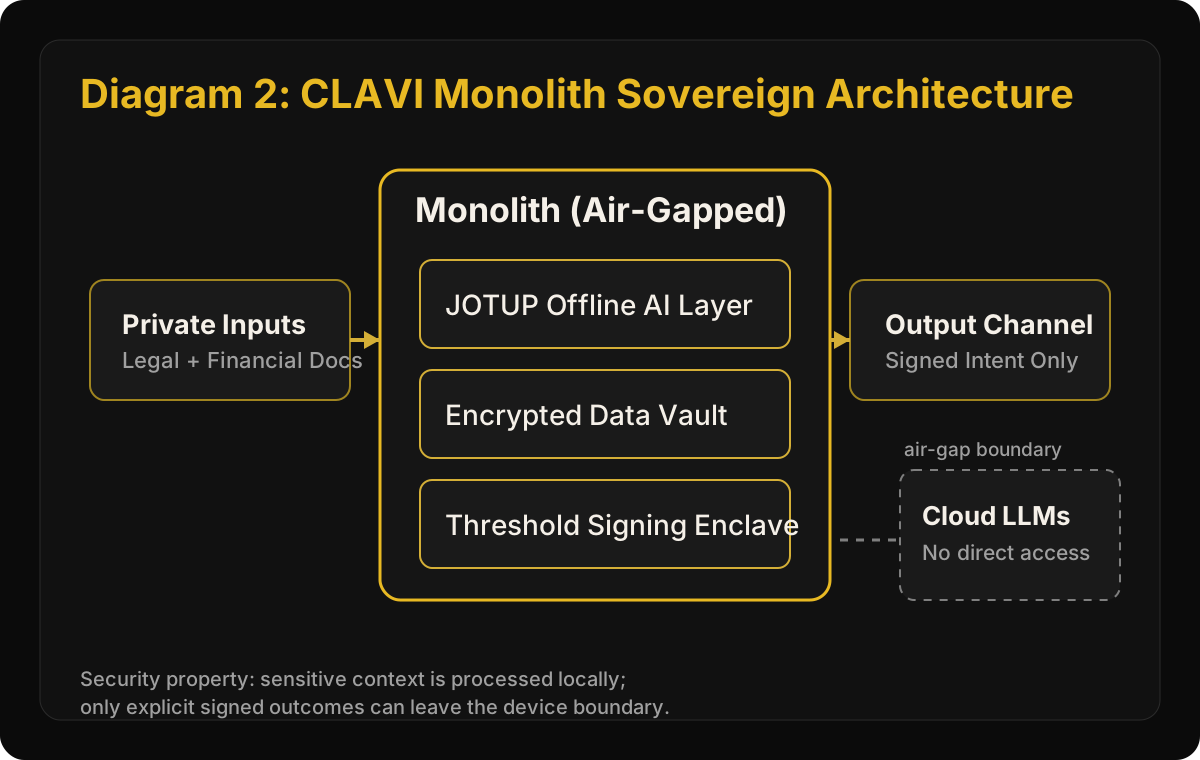
Each requirement addresses a failure mode that products alone cannot cover. No single device can deliver this. It requires an vault-level integration of hardware, software, authentication, and intelligence.
5. Succession Without Single Points of Failure
Every great family eventually confronts the same quiet terror: the founder who carries the combination in his head, the matriarch whose signature alone unlocks the trust, the individual whose sudden absence would turn a digital estate into a forensic puzzle.
Traditional succession instruments were designed for assets that exist in institutional registries. Crypto assets recognise no authority but the key. If the key is lost, inaccessible, or held by a single compromised individual, no court order and no legal instrument can recover it.
Generational crypto succession requires a fundamentally different model: distributed authority where signing power is spread across family members, trustees, and geographic locations, so that no single death, theft, or legal action can compromise the estate. Time-locked protocols that activate automatically under predefined conditions. Threshold governance that requires multiple parties to act in concert, ensuring continuity without concentrating control.
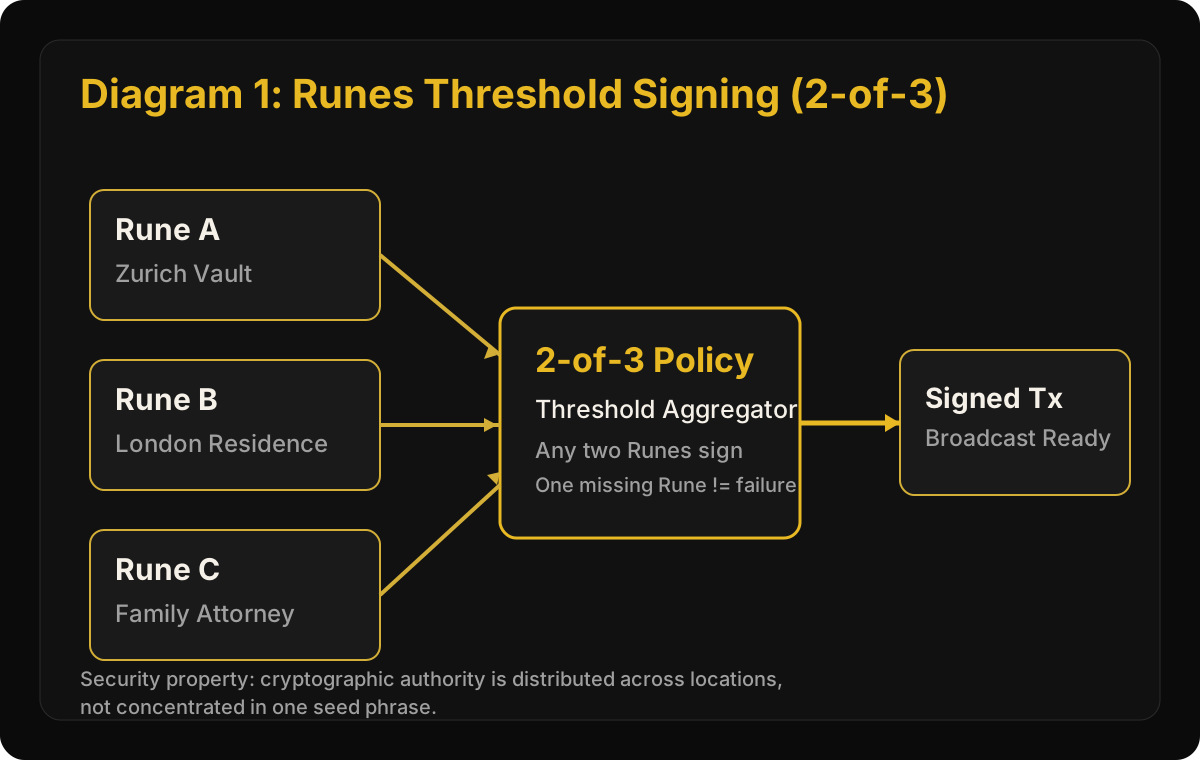
True succession is not a document. It is a system that knows what to do when you no longer can.
This is where the distinction between a custody product and a Personal Digital Vault becomes most consequential. For digital asset succession planning at the family office level, the difference is between a tool your heirs might inherit and an architecture they certainly will.
6. The Jurisdiction Question Nobody Asks Early Enough
There is a question that separates families who have thought seriously about sovereign crypto custody from those who have merely purchased security products: where does the architecture live, and whose laws govern it?
This is not a marketing consideration. It is a load-bearing architectural decision.
The US CLOUD Act [5] and the Five Eyes intelligence-sharing framework mean that any custody solution built on American or allied infrastructure answers, ultimately, to those governments. For a family office seeking genuine sovereignty, any custody solution built on this infrastructure carries an embedded jurisdictional vulnerability.
Swiss jurisdiction occupies a structurally distinct position. Governed by Article 13 of the Swiss Constitution [4], it establishes privacy as a fundamental right. Swiss law supports self-custody and does not compel key disclosure under the same frameworks that apply in EU or Five Eyes jurisdictions.
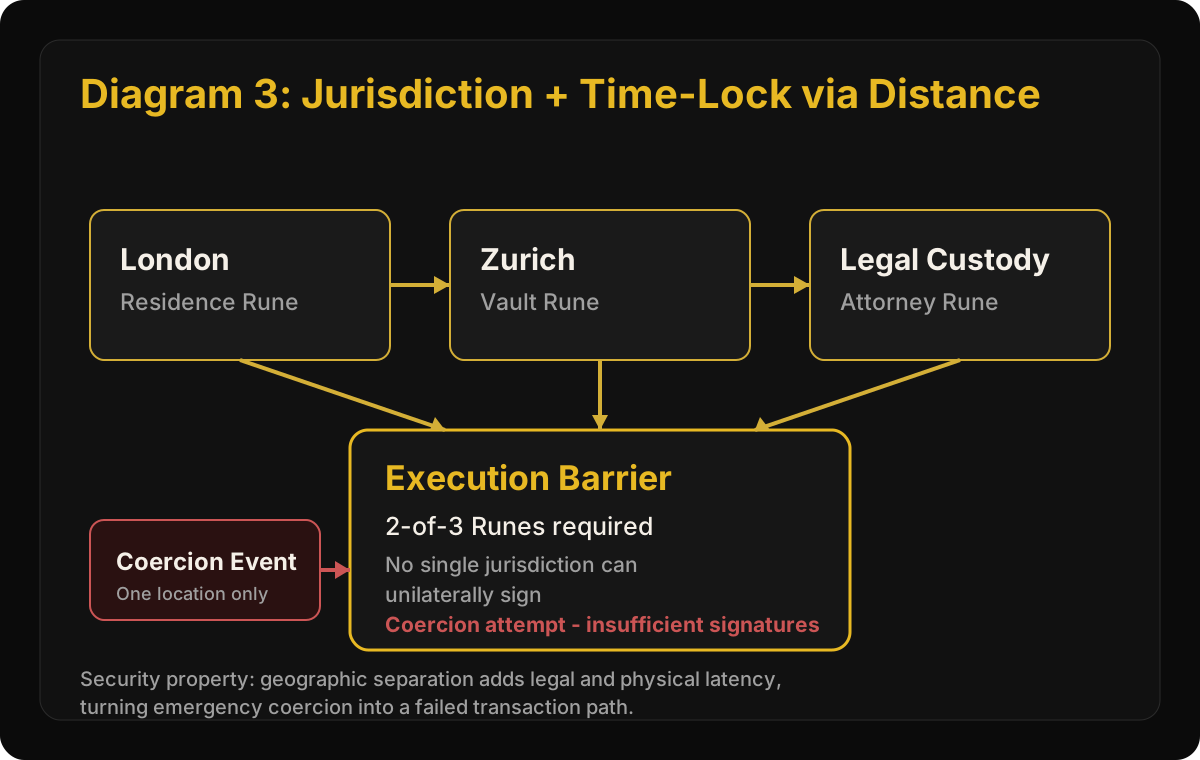
The jurisdiction question is about whether the legal environment in which your infrastructure operates is structurally aligned with your sovereignty, or structurally opposed to it.
7. Building the Foundation: From Private Custody to Private Intelligence
Three forces are converging to create a category that did not exist five years ago:
- The collapse of trust in centralised custodians. The cascade of exchange failures was a structural revelation. The $1.58 billion stolen from crypto services in the first half of 2024 alone [3] confirms the trend is accelerating.
- The AI privacy crisis. Every query to a cloud AI service is logged and analysed. For a family office using AI for tax strategy or estate planning, this creates an irreconcilable tension. Private AI is the minimum standard for any family whose queries contain information more valuable than the answers.
- The escalation of physical threats. When digital wealth is concentrated in devices that can be seized, the threat extends beyond the digital. Geographically distributed custody is the architectural response.
CLAVI Switzerland AG represents one implementation of this architecture. Their approach combines an air-gapped local node (The Monolith) with biometric authentication devices(Runes) distributed across locations, a zero-knowledge operating system, and CLAVI’s proprietary AI (JOTUP): a local tag-based RAG AI concierge that runs entirely offline.
The design philosophy is captured in a principle their team articulates with disarming simplicity: “Architecture enforces what policy cannot.”
The Monolith sits in your home or office. The Runes distribute signing authority across your family and geography. The AI analyses your data without transmitting it. The system is designed so that CLAVI itself, by mathematical construction, cannot access your keys or your queries. As explored in Why CLAVI Isn’t Competing with Ledger, this elevates custody to the level of an Apex Node.
8. A Final Observation
The question is not whether you trust your custodian. The question is whether your architecture requires you to.
For high-level businesses and families whose digital wealth represents not just capital but legacy, the answer to that question is becoming the defining infrastructure decision of this decade. The families who build sovereign foundations now—who treat their digital assets with the same generational seriousness they apply to property, art, and trusts—will find themselves, on some future Tuesday morning, reading the headlines over coffee. At peace. Unreachable.
The most expensive thing a family can own is a dependency it never audited. The most valuable thing it can build is an architecture that makes dependency unnecessary.
9. Glossary of Key Terms
Sovereignty. The condition of being subject to no higher authority. In CLAVI’s framework, sovereignty extends to digital assets, computation, and identity.
Apex Node. A sovereign infrastructure platform where cryptographic authority, private computation, and jurisdictional independence converge.
The Monolith. CLAVI’s sovereign processing core: an air-gapped computational unit that operates independently of any network, cloud, or external service.
The Rune. A biometrically secured hardware key used in distributed threshold signing schemes to eliminate single points of failure.
10. Frequently Asked Questions
Q: What is a Personal Digital Vault? A: A Personal Digital Vault is a comprehensive sovereign infrastructure that coordinates hardware custody, zero-knowledge architecture, private local AI, and distributed threshold signing. Unlike a standard hardware wallet which only signs transactions, a Personal Vault manages permissions, succession, and computation without reliance on third-party cloud services.
Q: How does CLAVI solve the crypto succession problem for family offices? A: CLAVI solves the inheritance problem through threshold signing via biometric Rune devices. Instead of relying on a single vulnerable seed phrase, cryptographic authority is geographically distributed among family members or fiduciaries. Role-based access allows view-only, partial signing, or full administrative control. Time-locked protocols ensure that the estate can be seamlessly recovered and transferred without single points of failure.
Q: Why is Swiss jurisdiction important for digital asset custody? A: Swiss jurisdiction provides constitutional privacy protections under Article 13 and operates outside the Five Eyes intelligence-sharing framework and the EU. When combined with CLAVI’s zero-knowledge architecture, this ensures that no foreign government or court can compel the disclosure of keys or private data.
Q: What is the custody trilemma in digital wealth management? A: The custody trilemma is the structural trade-off between convenience (exchanges), security (hardware wallets), and sovereignty (complete jurisdictional and architectural independence). Current solutions solve one or two, but only a sovereign Personal Digital Vault—like CLAVI’s Apex Node architecture—resolves all three simultaneously.
Q: How does CLAVI’s proprietary AI provide private AI for family offices? A: CLAVI’s proprietary AI, JOTUP, is a 100% offline tag-based RAG AI concierge that runs directly on the air-gapped Monolith. It prioritises accuracy over generation and allows family offices to process sensitive financial, legal, and strategic queries locally without exposing proprietary data to cloud-based LLM telemetry, ensuring absolute data sovereignty.
11. Works Cited
- Global Family Office Report. BNY Mellon Wealth Management. (https://www.bny.com/wealth)
- Web3 Security Report: The Rise of Physical Attacks. CertiK. (https://www.certik.com/)
- Mid-Year Crypto Crime Update 2024. Chainalysis. (https://www.chainalysis.com/)
- Swiss Federal Constitution, Article 13 (Right to Privacy). Fedlex. (https://www.fedlex.admin.ch/eli/cc/1999/404/en)
- CLOUD Act of 2018. U.S. Department of Justice. (https://www.justice.gov/dag/cloudact)
Written by 0NE, architect behind CLAVI’s sovereignty platform. For a deep dive into how bespoke hardware reflects status signalling, see The Two Faces of the Coin. To understand the technical disparities of threshold signing, explore Why CLAVI Isn’t Competing with Ledger.