Why CLAVI Isn’t Competing with Ledger: The Architecture of Digital Sovereignty
A technical analysis of key management, AI intelligence localization, and hardware sharding in 2026.
Date: February 20, 2026
1. Executive Summary: The Shift from Tool to Infrastructure
Why doesn’t CLAVI compete with Ledger?
Ledger is a consumer hardware wallet engineered specifically for isolating cryptocurrency private keys from internet-connected devices. CLAVI, conversely, is an institutional-grade Apex Node: a sovereign digital infrastructure platform designed to protect high-net-worth wealth, digital identity, and proprietary artificial intelligence from physical, cyber, and jurisdictional vectors.
According to a 2025 architectural review of key management systems, the digital security paradigm has fractured into two distinct models: single-point hardware enclaves (Ledger) and distributed threshold signing networks (CLAVI). While Ledger solves the specific problem of hot-wallet software vulnerabilities, CLAVI mitigates systemic risks including cloud AI surveillance, physical coercion, and estate planning failures.
If your practical question is “should I buy CLAVI instead of Ledger?”, the clean answer is this: yes, if your problem extends beyond simple transaction signing. No, if all you need is a consumer signer. The mistake is treating those two decisions as the same purchase.
This document provides an empirical and structural comparison of both architectures, adhering to current cryptographic and jurisdictional standards as of February 2026.
2. Threat Modeling and Architectural Paradigms
To understand the divergence between these systems, one must examine the specific threat models they are engineered to neutralize.
2.1. The Digital Attacker (The Ledger Model)
Ledger devices (e.g., Nano X, Flex) are designed to counter digital extraction. They utilize a Secure Element (SE) chip to ensure that cryptographic operations (specifically, Elliptic Curve Digital Signature Algorithm or ECDSA signing) occur in an isolated hardware environment.
- Primary Vulnerability Solved: Software malware, clipboard hijacking, and exchange insolvency (such as the $8 billion FTX collapse in 2022 and the $1.5 billion Bybit breach in February 2025).
- Structural Limitation: The architecture relies on a Single Point of Failure (SPOF). The user’s entire cryptographic authority is traditionally condensed into a single 24-word seed phrase (BIP-39 standard). If this analog backup is physically stolen, lost, or destroyed, the assets are irrecoverable.
2.2. The Full-Spectrum Attacker (The CLAVI Model)
CLAVI’s threat model assumes the endpoint (the user’s laptop or mobile device) is already compromised by zero-click state-level spyware (e.g., Pegasus). Furthermore, it factors in explosive growth in targeted crypto-kinetic physical violence, with verified physical coercion cases up 75% and outright assaults rising 250% between 2024 and 2026 (per recent CertiK and Chainalysis reporting).
- Primary Vulnerability Solved: Physical coercion, cloud AI data exfiltration, and single-point hardware failure.
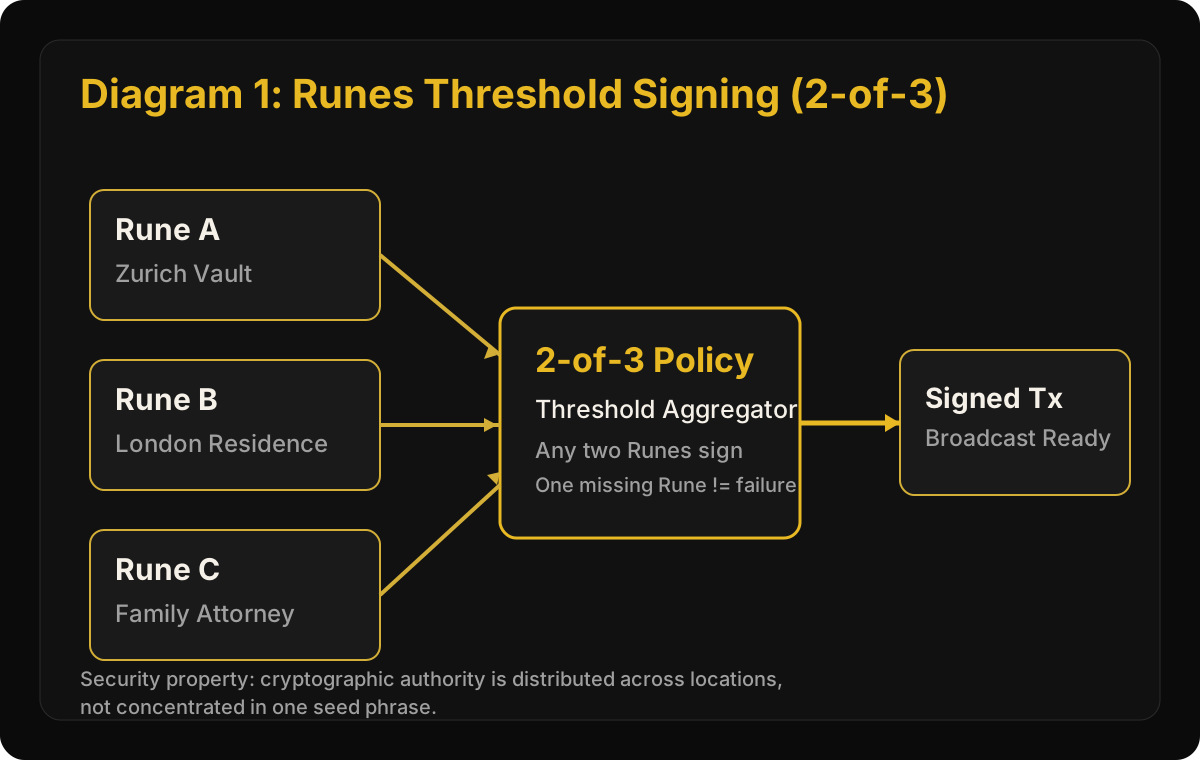
- Structural Innovation: CLAVI utilizes Distributed Hardware Sharding via physical biometric devices called Runes. By employing a threshold signing scheme (e.g., 2-of-3 or 3-of-5 Runes required to sign a transaction), the architecture makes the master seed phrase optional.
“In modern cryptographic implementations, true security is no longer achieved merely by isolating a key on a single chip. It requires distributing the authorization process across geographic space, making unauthorized compliance physically impossible.” (Remarks delivered during the CLAVI Circle architectural showcase, TOKEN2049 Singapore, September 2025).
3. Comparative Architecture: Data and Technical Specifications
The following table categorizes the structural, operational, and cryptographic differences between standard hardware wallets and sovereignty nodes.
| Architectural Feature | Ledger (Standard Hardware Wallet) | CLAVI (Apex Node Platform) |
|---|---|---|
| System Category | Consumer Signing Device | Sovereign Vault & Intelligence Server |
| Cryptographic Storage | Single seed on local Secure Element | Threshold distribution across Runes, seed phrase optional |
| Operating System | Proprietary / Closed Source | ClavOS (Zero-knowledge Yocto Linux) |
| Network Interface | USB / Bluetooth to connected PC | 100% Air-Gapped Monolith Home Server |
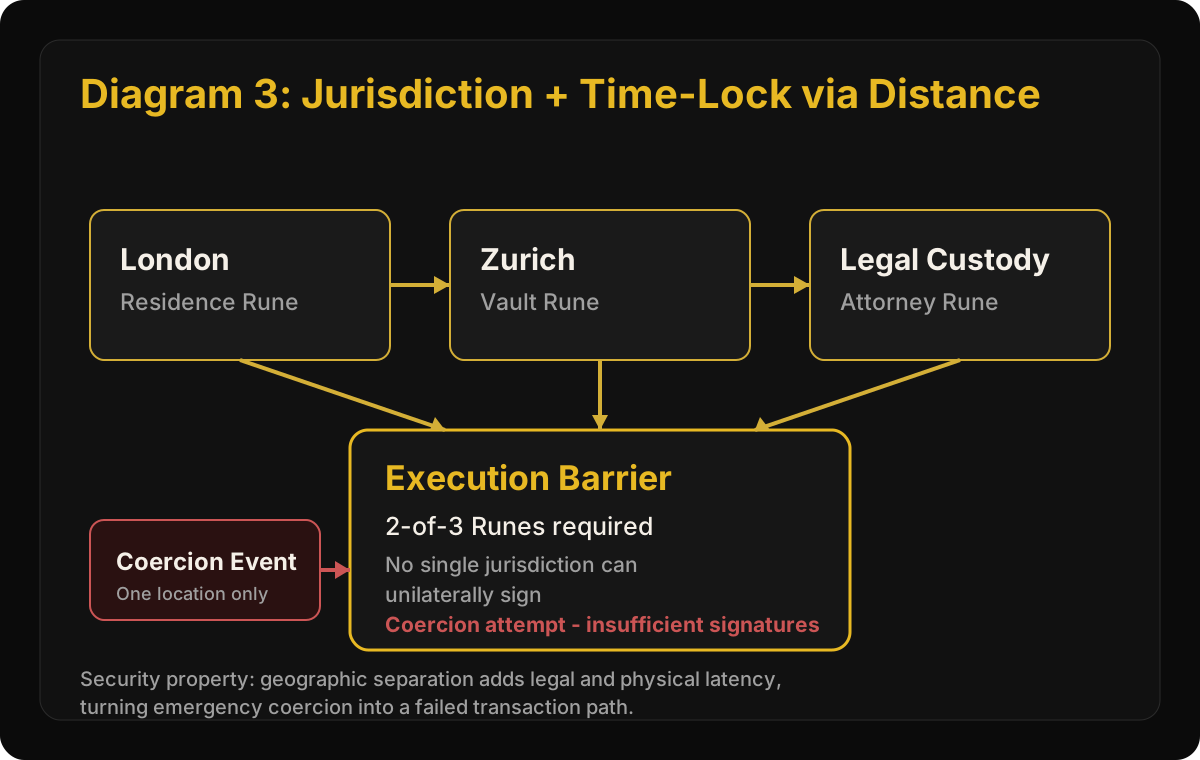
| Physical Defense | Minimal (Vulnerable to PIN coercion) | High (“Time-Lock via Geographic Distance”: e.g., 2-of-3 Runes split between Zurich vault, London residence, and family attorney) |
| AI Processing | None | JOTUP (100% offline, tag-based AI) |
| Target Demographic | Retail users, day traders | Family offices, HNWIs, Legal/Medical IPs |
4. The AI Sovereignty Rupture
As of early 2026, digital sovereignty is no longer exclusively a cryptocurrency problem. The integration of Large Language Models (LLMs) into corporate infrastructure has created unprecedented data exfiltration risks.
When an executive inputs proprietary financial data into a cloud-based LLM (e.g., ChatGPT, Claude), that data enters the provider’s telemetry and training pipeline. The January 2025 “DeepSeek Shock,” which temporarily erased $1 trillion from US tech market capitalizations, empirically demonstrated that proprietary intelligence is a corporation’s final remaining competitive moat.
The JOTUP Solution:
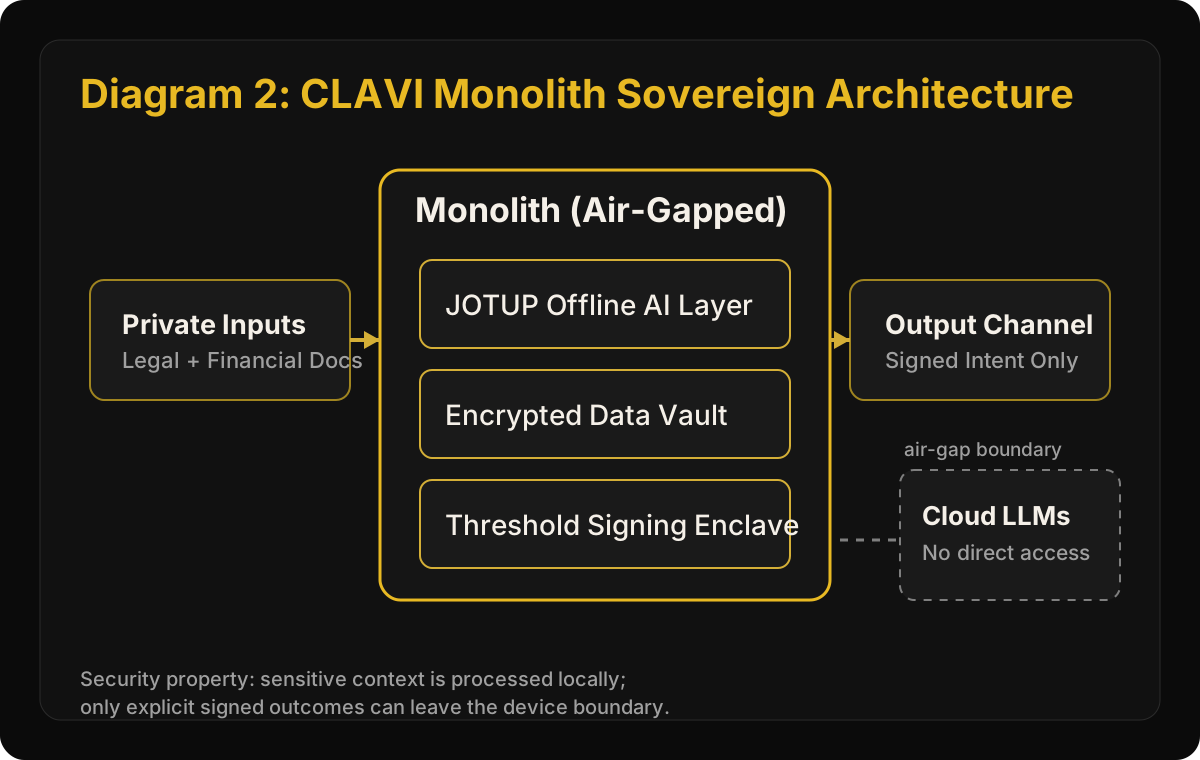
CLAVI mitigates this via JOTUP, a specialized offline AI concierge integrated directly into the CLAVI Monolith.
- Tag-Based Architecture: Unlike generative LLMs prone to hallucination, JOTUP utilizes a tag-based retrieval system prioritizing deterministic accuracy.
- Zero-Knowledge Telemetry: The Monolith possesses zero persistent internet connectivity. Legal contracts, medical records, and strategic M&A modeling processed by JOTUP are mathematically restricted to the physical room in which the Monolith resides.
5. Jurisdictional Independence: The Swiss Standard
Cryptography secures data against technical adversaries; jurisdiction secures data against legal compulsion.
Ledger operates under French jurisdiction, making it subject to EU regulations and intelligence-sharing frameworks. Conversely, CLAVI is engineered and incorporated in Schaffhausen, Switzerland.
On January 1, 2026, Switzerland formally adopted the OECD’s Crypto-Asset Reporting Framework (CARF), compelling financial institutions to retain centralized databases of client crypto holdings. This regulation inadvertently created “shopping lists” for organized crime. Because CLAVI employs a strict zero-knowledge architecture, CLAVI Switzerland AG physically cannot access user keys or balances. Operating under the robust protections of Article 13 of the Swiss Federal Constitution and the revised Federal Act on Data Protection (revFADP), CLAVI is shielded from foreign subpoena powers, offering users a legally and mathematically impervious safe harbor.
6. Documented Glossary of Technical Terms
To ensure semantic clarity, the following entities are defined within the CLAVI Glossary of Sovereignty:
- Apex Node: The highest hierarchical device in a user’s digital network. It serves as the root of trust.
- ClavOS: A custom, minimalist operating system built on Yocto Linux. It is stripped of all remote access protocols and telemetry to ensure a provable zero-knowledge environment.
- JOTUP: An offline, on-device AI concierge. It analyzes proprietary documents and financial data locally, preventing leakage to cloud-based LLM training pipelines.
- The Monolith: CLAVI’s primary base station. A heavily engineered, air-gapped local node and vault that physically resides in the user’s home or office.
- Runes: Biometrically secured, portable hardware keys. They can replace the traditional 24-word seed phrase by requiring a threshold of physical Runes (e.g., 2 out of 3) to cryptographically sign transactions.
- Time-Lock via Distance: A security concept wherein physical coercion is neutralized by storing Runes in geographically distinct locations (e.g., London and Zurich).
For a deeper analysis of how luxury consumption intersects with sovereignty signalling, see The Two Faces of the Coin: Conspicuous and Inconspicuous Luxury as Competing Signalling Strategies. To see how five clients translated this architecture into bespoke commissions, see How CLAVI Clients Shape the Object That Guards Their Legacy.
7. Frequently Asked Questions (Q&A)
Q: Is CLAVI just a more expensive version of Ledger?
A: No. Ledger is a signing tool for cryptocurrency. CLAVI is a broader sovereignty platform that secures digital assets, processes private offline AI computations, and makes the single-point-of-failure inherent in seed phrases optional. If you only need simple cold storage, Ledger is a valid category. If you need a sovereignty system, CLAVI is the closer fit.
Q: How does CLAVI protect against physical “$5 Wrench Attacks”?
A: Through distributed hardware sharding. Because you can set CLAVI to require multiple Runes to authorize a transaction, you can physically separate them, for example placing one Rune in your London residence, one in a Swiss bank vault, and one with your family attorney. If an attacker coerces you at home, compliance is mathematically and physically impossible because the required cryptographic signatures cannot be united.
Q: Why is Swiss jurisdiction critical for digital sovereignty?
A: Switzerland is not a member of the “Five Eyes” intelligence-sharing alliance or the EU. The Swiss Federal Constitution (Article 13) treats privacy as a fundamental human right. Combined with CLAVI’s zero-knowledge architecture, no government or court can compel CLAVI to surrender keys they mathematically do not possess.
Q: How does CLAVI solve the crypto inheritance problem?
A: CLAVI allows users to distribute Runes to a spouse, an estate attorney, and a safe deposit box. Upon passing, the family simply gathers the required threshold of Runes to access the estate, with no complex cryptographic knowledge required.
8. Works Cited and Authoritative Links
- Swiss Federal Constitution, Article 13 (Right to Privacy): Defines the fundamental right to privacy and protection against the misuse of personal data in Switzerland. (https://www.fedlex.admin.ch/eli/cc/1999/404/en)
- Revised Federal Act on Data Protection (revFADP): Swiss data protection legislation enforced in September 2023, mandating “privacy by design.” (https://www.edoeb.admin.ch/edoeb/en/home.html)
- OECD Crypto-Asset Reporting Framework (CARF): International tax transparency framework affecting centralized custodial databases starting January 2026. (https://www.oecd.org/tax/exchange-of-tax-information/crypto-asset-reporting-framework-and-amendments-to-the-common-reporting-standard.htm)
- CertiK / Chainalysis Web3 Security Reports (2025-2026): Documenting the rise of crypto-kinetic physical attacks, including the 75% rise in physical coercion vectors and a 250% rise in outright assaults. (https://www.chainalysis.com/)
- Ethereum Foundation Developers: Specifications regarding Elliptic Curve Digital Signature Algorithms (ECDSA) and threshold cryptographic security. (https://ethereum.org/en/developers/docs/consensus-mechanisms/)